Advertisement

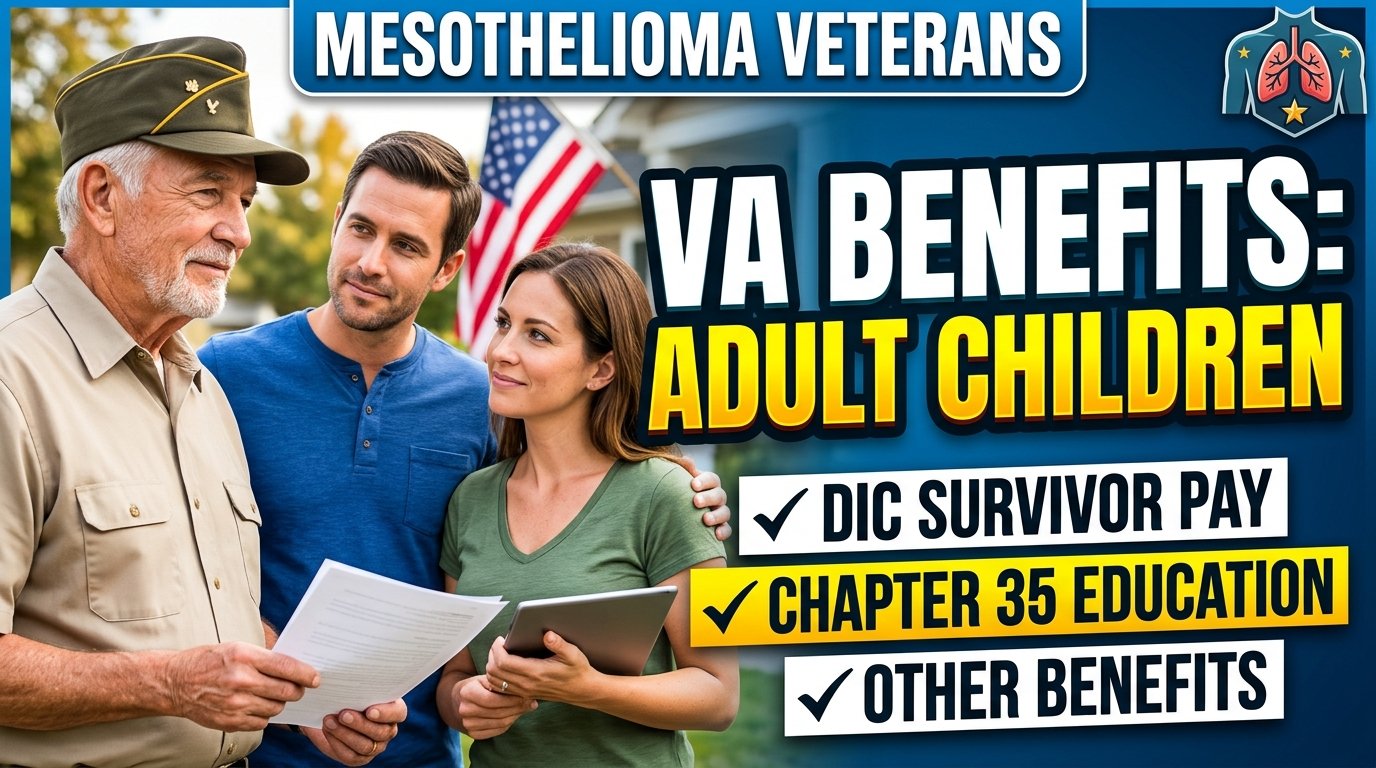
VA Benefits for Adult Children of Veterans with Mesothelioma: Dependency, Education, and Survivor Benefits

The Forgotten Dependents

Your parent served in the military. They were exposed to asbestos. Decades later, they were diagnosed with mesothelioma. You watched them fight. You helped them through treatment. You held their hand at the end.

Now they are gone. And you are left with grief, memories, and questions. Do you qualify for any VA benefits? Can you get help with college? Is there any financial assistance for adult children?

The answers are complicated. The VA’s benefits for adult children are more limited than for spouses. But there are programs that can help – with education, health care, and in some cases, monthly compensation.

This guide will walk you through everything you need to know about VA benefits for adult children of veterans who died from mesothelioma. You will learn about Chapter 35 education benefits, CHAMPVA health insurance, DIC for children, and other programs.

No complicated government language. No confusion. Just clear, honest information to help you navigate the benefits you may be eligible for.


Part 1: Overview of VA Benefits for Adult Children

The VA offers several benefits to surviving children of veterans who died from service-connected conditions like mesothelioma.

BenefitWhat It ProvidesEligibility
Chapter 35 (DEA)Monthly payments for college or job trainingAges 18-26 (some exceptions)
CHAMPVAHealth insurance coverageUnder 18 (or 18-23 if in school)
DIC for ChildrenMonthly compensation for disabled childrenAny age (if disabled before 18)
Burial benefitsHeadstone, flag, presidential certificateAll children (as next of kin)
Accrued benefitsBack pay owed to the veteranAll children (if no spouse)

Important: For adult children (age 18 and over), the most important benefit is Chapter 35 (DEA)education benefits. CHAMPVA generally ends at age 18 (or 23 if in school). DIC for children is only for children who became disabled before age 18.


Part 2: Chapter 35 – Survivors’ and Dependents’ Educational Assistance (DEA)

What Is Chapter 35?

Chapter 35 of the VA benefits code is also called Survivors’ and Dependents’ Educational Assistance (DEA) . It provides monthly payments to the surviving children (and spouses) of veterans who:

  • Died from a service-connected condition (mesothelioma qualifies), OR
  • Are permanently and totally disabled from a service-connected condition

For adult children of mesothelioma veterans, Chapter 35 is the most valuable benefit.

Who Is Eligible for Chapter 35?

You are eligible if:

  • Your parent served in the military, AND
  • Your parent died from a service-connected condition (mesothelioma), AND
  • You are the biological child, adopted child, or stepchild of the veteran, AND
  • You are between the ages of 18 and 26 (some exceptions apply)

Age Exceptions

  • You can start using Chapter 35 benefits at age 18 (or younger if you have graduated high school)
  • You can use benefits until age 26
  • If you are in the military, you can have benefits paused and resume later
  • In rare cases, extensions beyond age 26 are available for certain circumstances

What Education Programs Are Covered?

  • College or university (undergraduate and graduate degrees)
  • Vocational and technical training (trade schools, certificate programs)
  • Apprenticeships and on-the-job training
  • Correspondence courses
  • Flight training (with certain restrictions)
  • High school equivalency (GED) preparation

How Much Does Chapter 35 Pay?

The monthly payment depends on your enrollment status and type of training.

2026 Monthly Payment Rates (Estimated):

Enrollment StatusMonthly Payment
Full-time (12+ credit hours)$1,488.00
Three-quarter time (9-11 credit hours)$1,116.00
Half-time (6-8 credit hours)$744.00
Less than half-time (1-5 credit hours)Tuition and fees only (no monthly payment)

Apprenticeship/OJT rates: Vary based on length of training, starting at 75% of full-time rate and decreasing over time.

How Long Can You Use Chapter 35?

You have 45 months of full-time benefits. This is equivalent to about 4 years of college.

How to Apply for Chapter 35

Step One: Gather your documents.

  • Your birth certificate (proving you are the veteran’s child)
  • Your parent’s death certificate (showing mesothelioma as cause of death)
  • Your parent’s DD214
  • Your parent’s VA rating decision (if available)

Step Two: Complete VA Form 22-5490 (Application for Survivors’ and Dependents’ Educational Assistance).

Step Three: Submit online at VA.gov, by mail, or with help from a VSO.

Step Four: Once approved, you will receive a Certificate of Eligibility (COE). Bring this to your school’s financial aid office.

Important Tips

  • Apply early: Processing can take 2-3 months.
  • Coordinate with other aid: Chapter 35 can be used with other financial aid (Pell Grants, scholarships, student loans).
  • It is not retroactive: You do not get paid for semesters before you apply.

Part 3: CHAMPVA Health Insurance for Children

What Is CHAMPVA?

CHAMPVA (Civilian Health and Medical Program of the Department of Veterans Affairs) is a health insurance program for dependents of veterans who are permanently and totally disabled or who died from a service-connected condition.

Who Is Eligible for CHAMPVA as a Child?

You are eligible if:

  • Your parent died from a service-connected condition (mesothelioma), AND
  • You are the biological child, adopted child, or stepchild of the veteran, AND
  • You are under 18 years old, OR
  • You are between 18 and 23 and attending school full-time, OR
  • You became permanently disabled before age 18

What Does CHAMPVA Cover?

  • Doctor visits and specialist consultations
  • Hospital stays
  • Emergency room care
  • Prescription medications
  • Mental health care
  • Physical therapy
  • Durable medical equipment
  • Well-child visits and immunizations

What Does CHAMPVA Cost?

  • Annual deductible: 50perperson,50perperson,100 per family
  • Cost-share: 25% of covered services (after deductible)
  • Out-of-pocket maximum: $3,000 per year

When CHAMPVA Ends for Children

  • Age 18: Coverage ends unless you are still in high school (then coverage continues until graduation)
  • Age 23: Coverage ends for full-time students
  • No age limit: For children who were permanently disabled before age 18

How to Apply for CHAMPVA

Complete VA Form 10-7959c (Application for CHAMPVA Benefits). Submit by mail to the VA CHAMPVA Center in Denver, Colorado.


Part 4: DIC for Children (Dependency and Indemnity Compensation)

What Is DIC for Children?

Dependency and Indemnity Compensation (DIC) is a monthly, tax-free payment to surviving family members of veterans who died from service-connected conditions. For children, DIC is generally only available to children who are permanently disabled.

Who Is Eligible for DIC as a Child?

You are eligible for DIC if:

  • Your parent died from a service-connected condition (mesothelioma), AND
  • You are the biological child, adopted child, or stepchild of the veteran, AND
  • You are a minor (under 18), OR
  • You are between 18 and 23 and in school, OR
  • You are any age and became permanently disabled before age 18

How Much Does DIC Pay for Children?

SituationMonthly Payment (2026)
One child (no surviving spouse)600600−800 (estimated)
Two children (no surviving spouse)800800−1,000 (estimated)
Additional children+150150−200 per child

Note: If there is a surviving spouse, the payment goes to the spouse, not the children. Children may receive additional amounts added to the spouse’s DIC.

DIC for Adult Children with Disabilities

If you became permanently disabled before age 18, you can receive DIC for your entire life. You must provide:

  • Medical records documenting your disability
  • Evidence that the disability began before age 18
  • Evidence that you are unable to support yourself

Part 5: Accrued Benefits (Back Pay)

What Are Accrued Benefits?

When a veteran dies while a VA claim is pending, or if they die after filing a claim but before receiving payment, the money owed to them becomes accrued benefits. This money can be paid to surviving family members.

Who Qualifies for Accrued Benefits?

  • The surviving spouse (first priority)
  • Surviving children (if no spouse)
  • Surviving parents (if no spouse or children)

How to Claim Accrued Benefits

Complete VA Form 21P-601 (Application for Accrued Benefits). Submit it to the VA. You will need the veteran’s death certificate and claim information.


Part 6: VA Burial Benefits for Adult Children

As the surviving child of a veteran, you may be responsible for arranging your parent’s burial. The VA offers burial benefits that can help.

Burial Benefits Available

  • Reimbursement of burial expenses: Up to $2,000 for service-connected death (mesothelioma qualifies)
  • Headstone or marker: Free for any veteran
  • Burial flag: Free
  • Presidential Memorial Certificate: Free
  • National cemetery burial: Free gravesite, opening/closing, and perpetual care

How to Apply for Burial Benefits

Work with the funeral home. They can handle most of the paperwork. You can also apply directly through the VA National Cemetery Scheduling Office at 1-800-535-1117.


Part 7: State Veterans Benefits for Adult Children

Many states offer education benefits for children of veterans, including those who died from service-connected conditions.

Common State Benefits

  • Free or reduced tuition at state colleges and universities
  • Education grants specifically for children of deceased veterans
  • Veterans preference for state jobs (for children of veterans)

How to Find State Benefits

Search online for “[your state] veterans benefits for dependents” or contact your state’s Department of Veterans Affairs.

Prominent State Programs

  • Texas (Hazlewood Act): Children of deceased veterans can receive up to 150 credit hours of free tuition at Texas public colleges.
  • Florida: Children of deceased veterans may be eligible for tuition waivers at Florida public colleges.
  • California: Dependent fee waiver for children of deceased veterans at California public colleges.
  • Illinois: Illinois Veteran Grant for children of deceased veterans.

Part 8: Social Security Survivor Benefits

In addition to VA benefits, adult children may be eligible for Social Security survivor benefits.

Who Qualifies for Social Security Survivor Benefits?

  • You are the unmarried child of a deceased parent, AND
  • You are under 18 (or under 19 and still in high school), OR
  • You are any age and became disabled before age 22

How Much Does Social Security Pay?

Benefits are based on the parent’s earnings history. The average monthly benefit for a child is approximately 800800−1,200.

How to Apply for Social Security Survivor Benefits

Contact the Social Security Administration at 1-800-772-1213 or visit www.ssa.gov.


Frequently Asked Questions

How long do I have to use Chapter 35 benefits?
You have until age 26 to use your benefits. Some exceptions exist for military service.

Can I use Chapter 35 for graduate school?
Yes. Chapter 35 benefits can be used for master’s degrees, PhDs, and professional programs (law school, medical school).

What if I am over 26 and never used Chapter 35?
In most cases, you have lost your benefits. However, there are exceptions for veterans who were on active duty or had other extenuating circumstances.

Can I receive Chapter 35 and Social Security survivor benefits at the same time?
Yes. They are separate programs. One does not affect the other.

What if my parent did not have a VA rating before they died?
You can still apply for survivor benefits. The VA will determine if your parent’s mesothelioma was service-connected as part of your application.

Where can I get help with my application?
Contact a Veterans Service Officer (VSO) from the American Legion, VFW, or DAV. Their services are free.


Resources


Final Thoughts: You Are Not Forgotten

Losing a parent to mesothelioma is devastating. The grief is heavy. But you are not forgotten. The VA offers benefits to help you pursue your education, access health care, and in some cases, receive monthly financial support.

Chapter 35 can pay for college or trade school. CHAMPVA can provide health insurance until age 23. State programs may offer free tuition. Social Security may provide survivor benefits.

Do not assume you do not qualify. Check. Apply. Get the benefits you and your family have earned through your parent’s service and sacrifice.


Disclaimer: This article provides general information about VA benefits for adult children of veterans who died from mesothelioma. It does not constitute legal advice or official VA guidance. VA benefits rules change. Every situation is different. Always consult with a qualified Veterans Service Officer, VA-accredited attorney, or the VA directly about your specific situation.

VA Pension for Mesothelioma Veterans: Benefits for Low-Income Wartime Veterans Without a Service Connection

The Benefit You May Not Know About

You have mesothelioma. You need help. But there is a problem. You cannot prove your mesothelioma came from your military service. Maybe you served during peacetime. Maybe you served in a job that did not expose you to asbestos. Maybe you just cannot find the evidence.

Does this mean you get nothing from the VA? No.

There is a VA benefit called the VA Pension. It is a needs-based benefit for wartime veterans with limited income and assets. It does not require your mesothelioma to be service-connected. You just need to have served during wartime, have a disability, and have low income.

For veterans with mesothelioma who are not eligible for disability compensation, the VA Pension can provide a monthly, tax-free payment to help cover living expenses.

This guide will walk you through everything you need to know about the VA Pension for veterans with mesothelioma. You will learn who qualifies, how much money you can receive, how to apply, and how it differs from VA disability compensation.

No complicated government language. No confusion. Just clear, honest information to help you get the benefits you deserve.


Part 1: VA Disability Compensation vs. VA Pension

Before we dive in, let us clarify the difference between these two VA benefits.

FeatureVA Disability CompensationVA Pension
What is it?Monthly payment for service-connected disabilitiesMonthly payment for low-income wartime veterans
Service connection required?Yes (your disability must be caused by service)No
Income limit?NoYes (needs-based)
Asset limit?NoYes (needs-based)
Wartime service required?NoYes
Disability required?YesYes (must be permanently disabled)
Taxable?NoNo

Which Benefit Is Better for Mesothelioma?

If your mesothelioma is service-connected: VA Disability Compensation is better. It pays more. There is no income or asset limit. You can work (if you are able) and still receive payments.

If your mesothelioma is NOT service-connected, or if you are waiting for a decision on your service connection claim: VA Pension may be available to you. It pays less than disability compensation, but it is better than nothing.


Part 2: What Is the VA Pension?

The Simple Explanation

The VA Pension is a monthly, tax-free payment to low-income wartime veterans who are permanently and totally disabled. It is also called the “Improved Pension.”

The pension is designed to help veterans who cannot work and have limited income cover their basic living expenses – food, housing, utilities, and medical costs.

Who Qualifies for VA Pension?

To qualify for VA Pension, you must meet four requirements.

Requirement 1: Wartime service.
You must have served at least 90 days of active duty, with at least one day during a wartime period.

Requirement 2: Discharge status.
You must have received a discharge other than dishonorable.

Requirement 3: Disability.
You must be permanently and totally disabled. Mesothelioma qualifies as a permanent and total disability.

Requirement 4: Income and assets.
Your income must be below a certain limit. Your assets (net worth) must be below a certain limit.

Wartime Periods Recognized by the VA

War/PeriodStart DateEnd Date
World War IIDecember 7, 1941December 31, 1946
Korean ConflictJune 27, 1950January 31, 1955
Vietnam WarNovember 1, 1955May 7, 1975
Persian Gulf WarAugust 2, 1990Present (still ongoing)

Note about Gulf War: The Persian Gulf War period is still open. Veterans who served after August 2, 1990, including those who served in Afghanistan and Iraq, qualify as Gulf War-era veterans.

What Qualifies as “Permanently and Totally Disabled”?

For mesothelioma, this is straightforward. Mesothelioma is a terminal cancer. The VA considers it a permanent and total disability. You do not need to prove anything else.

For other conditions, you would need a doctor’s statement. For mesothelioma, your diagnosis is enough.


Part 3: How Much Does VA Pension Pay?

The VA Pension has a Maximum Annual Pension Rate (MAPR) . The amount depends on your family situation and whether you need Aid and Attendance.

2026 VA Pension Rates (Estimated)

Family SituationMAPR (Annual)Monthly Payment
Veteran alone$16,964.78$1,413.73
Veteran with spouse$22,215.85$1,851.32
Veteran with one dependent child (no spouse)$22,215.85$1,851.32
Veteran with spouse and one child$23,624.85$1,968.74
+ Aid and Attendance (veteran needs help)+$11,413.76Additional $951.15/month
+ Housebound (veteran cannot leave home)+$2,813.76Additional $234.48/month

Important: Your Income Reduces the Payment

The VA Pension is needs-based. You do not receive the full MAPR amount. Instead, the VA subtracts your income from the MAPR.

Formula: Your Pension = MAPR – Your Annual Income

Examples

Example 1: A single veteran with no dependents, MAPR = 16,965.Theveteransincome(SocialSecurity,etc.)is16,965.Theveteransincome(SocialSecurity,etc.)is10,000 per year.

  • Pension = 16,96516,965−10,000 = 6,965peryear(6,965peryear(580 per month)

Example 2: A married veteran with Aid and Attendance, MAPR = 22,216+22,216+11,414 = 33,630.Thecouplescombinedincomeis33,630.Thecouplescombinedincomeis15,000 per year.

  • Pension = 33,63033,630−15,000 = 18,630peryear(18,630peryear(1,552 per month)

What Income Counts?

  • Social Security benefits
  • Railroad retirement
  • Other retirement or pension income
  • Interest and dividends
  • Rental income (after expenses)
  • Spouse’s income (for married couples)

What Income Does NOT Count?

  • VA disability compensation
  • Food stamps (SNAP)
  • Housing assistance
  • Medicaid payments
  • Gift money (under certain limits)

Asset Limit (Net Worth)

The VA also has an asset limit. Your net worth (all assets minus debts) must be below approximately $150,000 (subject to annual adjustment).

Assets that count:

  • Bank accounts (checking and savings)
  • Stocks, bonds, and mutual funds
  • Real estate (other than your primary home)
  • Vehicles (other than one personal vehicle)

Assets that do NOT count:

  • Your primary home
  • One vehicle
  • Personal belongings (furniture, clothing)
  • Prepaid burial plots and funeral plans

Part 4: Aid and Attendance for VA Pension

If you need help with daily activities, you can receive an additional payment called Aid and Attendance (A&A) on top of your VA Pension.

Who Qualifies for Aid and Attendance?

You qualify if you need help with:

  • Bathing (getting in and out of the tub, washing yourself)
  • Dressing (putting on clothes, buttoning buttons)
  • Eating (feeding yourself)
  • Using the bathroom (getting on and off the toilet)
  • Transferring (getting in and out of bed or a chair)

How Much Extra Does Aid and Attendance Add?

For 2026, Aid and Attendance adds approximately **11,414peryear(11,414peryear∗∗(951 per month) to your MAPR.

How to Apply for Aid and Attendance

When you apply for VA Pension, check the box for Aid and Attendance. You will need a doctor’s statement confirming that you need help with daily activities.


Part 5: VA Pension for Surviving Spouses

If the veteran passes away, the surviving spouse may be eligible for Survivors Pension (also called Death Pension).

Who Qualifies for Survivors Pension?

  • You were married to the veteran at the time of death
  • The veteran served wartime service (same rules as above)
  • Your income is below the MAPR for survivors

2026 Survivors Pension Rates (Estimated)

Family SituationMAPR (Annual)Monthly Payment
Surviving spouse alone$11,382.78$948.57
Surviving spouse with one dependent child$14,894.78$1,241.23
+ Aid and Attendance+$7,229.76+$602.48/month
+ Housebound+$2,813.76+$234.48/month

Part 6: How to Apply for VA Pension

Step One: Gather Your Documents

You will need:

  • Your DD214 (military discharge papers)
  • Your mesothelioma diagnosis (doctor’s letter, biopsy report)
  • Evidence of your income (Social Security statement, tax returns, pension statements)
  • Evidence of your assets (bank statements, investment statements)
  • Marriage certificate (if applying with spouse)
  • Children’s birth certificates (if applying with dependents)

Step Two: Complete VA Form 21P-527EZ

VA Form 21P-527EZ is the “Application for Veterans Pension.” It is similar to the disability compensation form but asks about your income and assets.

Where to get the form:

  • Download from VA.gov
  • Pick up from your local VA regional office
  • Request by mail

Step Three: Submit Your Application

Submit online at VA.gov, by mail, or with the help of a VSO.

Step Four: Wait for a Decision

VA Pension claims typically take 3-6 months to process. If you have a terminal diagnosis, request expedited processing.


Part 7: VA Pension vs. VA Disability Compensation – Which Should You Apply For?

If Your Mesothelioma Is Service-Connected

Apply for VA Disability Compensation. It pays more and has no income or asset limits.

If Your Mesothelioma Is Not Service-Connected

Apply for VA Pension. It will provide monthly income while you work on your service connection claim.

If You Are Waiting for a Decision on Your Service Connection Claim

You can apply for VA Pension while you wait. If your disability compensation claim is later approved, the VA will switch you over. You may have to repay some pension payments (the VA will figure this out).

Can You Receive Both?

Generally, no. You cannot receive both VA Disability Compensation and VA Pension at the same time. The VA will pay you whichever is higher.


Part 8: VA Pension vs. Medicaid vs. SSI

The VA Pension is one of several needs-based benefits for low-income disabled individuals.

BenefitSourceDisability required?Asset limitIncome limit
VA PensionVAYes (permanent disability)~$150,000Yes
MedicaidState governmentYes (medical need)Very low (~$2,000)Yes
SSISocial SecurityYesVery low (~$2,000)Yes

Note about Medicaid and SSI

If you qualify for VA Pension, you may also qualify for Medicaid and SSI. Apply for all benefits you are eligible for. A VSO or elder law attorney can help.


Frequently Asked Questions

Do I need a service connection for VA Pension?
No. VA Pension does not require your disability to be service-connected.

Can I work and still receive VA Pension?
No. VA Pension requires you to be permanently and totally disabled. If you are working, you are not considered disabled.

What if my income is above the limit?
You may still qualify if you have high medical expenses. The VA allows you to deduct unreimbursed medical expenses from your income.

How do medical expenses affect VA Pension?
The VA subtracts your annual medical expenses from your income. If your medical expenses are high enough, they can reduce your countable income below the limit.

Medical expenses that count:

  • Health insurance premiums
  • Medicare premiums
  • Prescription drug costs
  • Doctor and hospital bills not covered by insurance
  • Long-term care costs
  • Home health aide costs
  • Medical equipment (wheelchairs, oxygen, hospital beds)

Can I get VA Pension if I am in a nursing home?
Yes. If you are a wartime veteran in a nursing home and have limited income, you may qualify for VA Pension. The Aid and Attendance rate is often available.

What if my claim for VA Pension is denied?
You can appeal, just like disability compensation claims. Get help from a VSO or VA-accredited attorney.


Resources


Final Thoughts: You May Qualify for More Than You Think

You have mesothelioma. You cannot work. Money is tight. But you served your country during wartime. You may be eligible for VA Pension – a monthly, tax-free payment to help you cover basic living expenses.

Even if you are waiting for a decision on your service connection claim, apply for VA Pension now. You can always switch later.

Do not assume you do not qualify. Do not let pride stop you from applying. You earned these benefits.

Apply today.


Disclaimer: This article provides general information about the VA Pension program for veterans with mesothelioma. It does not constitute legal advice, financial advice, or official VA guidance. VA benefits rules change. Income and asset limits are adjusted annually. Every veteran’s situation is different. Always consult with a qualified Veterans Service Officer, VA-accredited attorney, or financial professional about your specific situation.

VA Pain Management, Palliative Care, and Hospice for Mesothelioma Veterans: Living Comfortably at Every Stage

The Symptom That Cannot Be Ignored

You have mesothelioma. The tumor presses against your chest wall. The fluid builds up around your lung. The cancer has spread to your ribs or your spine. The pain is constant. It wakes you up at night. It makes every breath a struggle.

You are already dealing with fatigue, shortness of breath, and the side effects of treatment. You should not have to deal with uncontrolled pain on top of everything else.

Here is what you need to know. The VA takes pain management seriously. They offer a full range of services to help you live comfortably, no matter what stage of mesothelioma you are in.

  • Pain management: Medications, nerve blocks, and other treatments to control your pain
  • Palliative care: Symptom management and quality of life support at any stage of illness
  • Hospice care: Comfort-focused care for veterans with terminal illness

This guide will walk you through everything you need to know about VA pain management, palliative care, and hospice for veterans with mesothelioma. You will learn what services are available, how to access them, and how to live as comfortably as possible.

No complicated government language. No confusion. Just clear, honest information to help you and your family navigate this difficult journey.


Part 1: Understanding Mesothelioma Pain

Where Does Mesothelioma Pain Come From?

Mesothelioma causes pain in several ways.

Tumor pressure: The tumor grows and presses on nerves, organs, and bones. Pleural mesothelioma presses on the chest wall and ribs. Peritoneal mesothelioma presses on the abdomen and digestive organs.

Fluid buildup: Fluid accumulates around the lung (pleural effusion) or in the abdomen (ascites). The pressure causes pain and discomfort.

Treatment side effects: Surgery, chemotherapy, and radiation can cause pain during and after treatment.

Nerve involvement: The cancer may grow into or around nerves, causing neuropathic pain (burning, shooting, tingling).

Types of Pain

Pain TypeDescriptionCommon in Mesothelioma
Somatic painAching, throbbing, localizedChest wall, ribs, abdomen
Visceral painCramping, pressure, deepAbdomen (peritoneal mesothelioma)
Neuropathic painBurning, shooting, tinglingNerves in chest or abdomen
Breakthrough painSudden, severe pain despite medicationCommon in advanced cancer

Why Pain Management Matters

Uncontrolled pain does more than make you uncomfortable. It can:

  • Interfere with sleep (leading to fatigue and depression)
  • Reduce appetite (leading to weight loss and weakness)
  • Limit mobility (leading to blood clots and pressure sores)
  • Worsen anxiety and depression
  • Reduce your ability to enjoy time with family

Controlling pain is not a luxury. It is an essential part of cancer care.


Part 2: VA Pain Management Services for Mesothelioma

Medications

The VA prescribes a full range of pain medications.

Non-opioid medications (for mild to moderate pain):

  • Acetaminophen (Tylenol)
  • Non-steroidal anti-inflammatory drugs (ibuprofen, naproxen)
  • COX-2 inhibitors (celecoxib)

Adjuvant medications (for neuropathic pain):

  • Gabapentin (Neurontin)
  • Pregabalin (Lyrica)
  • Amitriptyline
  • Duloxetine (Cymbalta)

Opioid medications (for moderate to severe pain):

  • Morphine
  • Oxycodone
  • Hydrocodone
  • Fentanyl (patch for continuous pain)
  • Hydromorphone (Dilaudid)

Breakthrough pain medications (quick-acting for sudden severe pain):

  • Immediate-release morphine or oxycodone
  • Fentanyl lozenges or lollipops

Interventional Pain Management

When medications are not enough, the VA offers procedures to block pain signals.

Nerve blocks: Injecting anesthetic around specific nerves to stop pain signals.

Epidural injections: For pain radiating from the spine.

Celiac plexus block: For abdominal pain from peritoneal mesothelioma.

Radiofrequency ablation: Using heat to destroy pain-causing nerves.

How to Access VA Pain Management

Step One: Tell your VA provider you are in pain. Be specific.

  • Where is the pain?
  • How bad is it on a scale of 1 to 10?
  • What does it feel like (aching, burning, shooting)?
  • When does it occur (constant, with movement, at night)?
  • What makes it better or worse?

Step Two: Ask for a referral to the VA Pain Clinic. Most VA medical centers have specialized pain management teams.

Step Three: Work with the pain team to develop a plan. This may include medications, procedures, physical therapy, and other approaches.


Part 3: Palliative Care for Mesothelioma Veterans

What Is Palliative Care?

Palliative care is specialized medical care focused on relieving symptoms and improving quality of life. It is NOT the same as hospice.

FeaturePalliative CareHospice Care
When it startsAt any stage of illnessTypically in last 6 months of life
Can you continue treatment?YesNo (curative treatment stops)
FocusSymptom management + quality of lifeComfort + dignity at end of life
Pain managementYesYes
Emotional supportYesYes
Spiritual supportYesYes

Why Palliative Care Matters for Mesothelioma

Mesothelioma causes many symptoms beyond pain:

  • Shortness of breath
  • Fatigue
  • Nausea and vomiting
  • Loss of appetite
  • Anxiety and depression
  • Insomnia

Palliative care addresses all of these. A palliative care team includes:

  • Doctors (pain specialists)
  • Nurses
  • Social workers
  • Chaplains (spiritual support)
  • Mental health counselors

How to Access VA Palliative Care

Step One: Ask your VA provider for a referral to palliative care.

Step Two: The palliative care team will meet with you and your family to discuss your symptoms, goals, and preferences.

Step Three: They will create a plan to manage your symptoms and support your quality of life.

Step Four: You continue your mesothelioma treatment (surgery, chemotherapy, immunotherapy, radiation) while receiving palliative care.

Important: You do not have to stop treatment to receive palliative care. In fact, studies show that patients who receive palliative care alongside treatment often live longer and feel better.


Part 4: Hospice Care for Veterans with Terminal Mesothelioma

What Is Hospice Care?

Hospice care is for veterans who have decided to stop curative treatment and focus on comfort and dignity at the end of life. Hospice is typically for patients with a life expectancy of six months or less.

What Hospice Provides

  • Pain and symptom management: Medications, oxygen, and other treatments to keep you comfortable
  • Nursing care: Regular visits from hospice nurses
  • Home health aides: Help with bathing, dressing, and other daily activities
  • Medical equipment: Hospital bed, oxygen, wheelchair, walker, commode
  • Medications: All medications related to your terminal diagnosis
  • Emotional support: Counseling for you and your family
  • Spiritual support: Chaplain services
  • Bereavement support: Grief counseling for your family after you pass

VA Hospice Benefits

The VA offers hospice care to veterans with terminal conditions like mesothelioma. Hospice can be provided in:

  • Your home (most common)
  • A VA medical center (if you need 24-hour nursing care)
  • A community hospice facility (through VA Community Care)
  • A nursing home (if you are already a resident)

How to Access VA Hospice Care

Step One: Talk to your VA provider about hospice. You can make this decision at any time.

Step Two: Ask for a referral to the VA Hospice and Palliative Care Program.

Step Three: A hospice team will meet with you and your family. They will explain your options and create a care plan.

Step Four: Hospice services begin. You will receive regular visits from nurses, aides, chaplains, and social workers.

Does Hospice Mean Giving Up?

No. Choosing hospice is not giving up. It is choosing to focus on what matters most: comfort, dignity, and time with your family. Many veterans report that starting hospice brought them peace.


Part 5: Complementary and Integrative Pain Management

In addition to medications and procedures, the VA offers complementary therapies for pain and symptom management.

Covered Complementary Therapies

  • Acupuncture: Thin needles inserted at specific points to relieve pain
  • Chiropractic care: Spinal manipulation for back and neck pain
  • Massage therapy: Gentle massage to reduce muscle tension and promote relaxation
  • Yoga and Tai Chi: Gentle movement and breathing exercises
  • Meditation and mindfulness: Techniques to reduce stress and manage pain
  • Biofeedback: Learning to control physiological responses (heart rate, muscle tension)

How to Access Complementary Therapies

Ask your VA provider for a referral. Some therapies require a referral to the VA’s Integrative Health department.


Part 6: VA Home-Based Care

If you want to stay at home rather than go to a facility, the VA offers home-based care options.

Home-Based Primary Care (HBPC)

For veterans who cannot easily travel to the VA, HBPC brings primary care to your home. A team of doctors, nurses, social workers, and therapists visits you at home.

Home Telehealth

You receive monitoring equipment (blood pressure cuff, pulse oximeter, scale) and report your vitals daily. A VA nurse monitors your readings and calls you if something is wrong.

Homemaker and Home Health Aide Services

The VA can provide aides to help with:

  • Bathing and dressing
  • Meal preparation
  • Light housekeeping
  • Grocery shopping
  • Medication reminders

How to Access Home-Based Care

Ask your VA provider for a referral to Home-Based Primary Care or the Homemaker and Home Health Aide program.


Part 7: Pain Management and Palliative Care for Caregivers

If you are caring for a veteran with mesothelioma, you also need support.

Respite Care

The VA provides respite care – temporary relief for caregivers. A trained caregiver takes over for a few days so you can rest. Respite can be provided in your home or at a VA facility.

Caregiver Support Groups

Many VA medical centers offer support groups for caregivers. You can share experiences, learn from others, and get emotional support.

Mental Health Services for Caregivers

Caregivers can access individual counseling through the VA’s Caregiver Support Program. Call 1-855-260-3274.


Frequently Asked Questions

Will opioids make me addicted?
When used properly for cancer pain, addiction is rare. Your pain management team will monitor you closely. Do not let fear of addiction stop you from getting pain relief.

Does the VA offer medical marijuana for pain?
No. The VA is a federal agency and cannot prescribe or recommend medical marijuana. However, the VA does not prohibit veterans from using it where it is legal. Talk to your doctor.

Can I receive palliative care and continue chemotherapy?
Yes. Palliative care can be provided alongside any treatment. It is not just for end of life.

How do I know if it is time for hospice?
Talk to your doctor. Generally, hospice is appropriate when you have stopped curative treatment and have a life expectancy of six months or less.

What if I start hospice and then change my mind?
You can stop hospice at any time. You can resume curative treatment if you wish. There is no penalty.

Does the VA pay for hospice at home?
Yes. The VA covers hospice care in your home, in a VA facility, or in a community hospice facility.


Resources

  • VA Pain Management: Ask your local VA medical center for the Pain Clinic
  • VA Palliative Care and Hospice: www.va.gov/geriatrics/palliative_care.asp
  • VA Home-Based Primary Care: www.va.gov/geriatrics/hbpc.asp
  • VA Caregiver Support Line: 1-855-260-3274
  • Veterans Crisis Line (for emotional support): 988 (press 1)
  • Patient Advocate (if you cannot access pain care): Ask your local VA medical center

Final Thoughts: You Deserve to Be Comfortable

Mesothelioma is a devastating disease. The pain can be overwhelming. But you do not have to suffer in silence. The VA has pain management, palliative care, and hospice services to help you live as comfortably as possible.

Do not wait until the pain is unbearable to ask for help. Talk to your VA provider today. Tell them about your pain. Ask for a referral to pain management. Ask about palliative care. Ask about hospice when the time comes.

You served your country. You deserve to be comfortable. You deserve to be at peace. Let the VA help you.


Disclaimer: This article provides general information about VA pain management, palliative care, and hospice for veterans with mesothelioma. It does not constitute medical advice. Every patient’s situation is different. Always consult with your VA provider about the best pain management and end-of-life care options for your specific situation. If you are having thoughts of suicide, call 988 immediately – help is available.

VA Accredited Attorneys for Mesothelioma Claims: When to Hire a Lawyer and How They Can Help

The Question Every Veteran Asks at Some Point

You have filed your VA claim for mesothelioma. Or you are trying to file. But something is wrong. The VA denied your claim. Or they approved it but at the wrong rating. Or they have been sitting on your case for months with no movement.

You are frustrated. You are tired. You are sick. You are starting to wonder: Do I need a lawyer?

The answer is not always yes. Many mesothelioma claims can be handled successfully by a Veterans Service Officer (VSO) for free. But there are times when hiring a VA-accredited attorneyis the smartest decision you can make.

VA-accredited attorneys are lawyers who have been specially trained and approved by the VA to represent veterans in claims and appeals. They can charge a fee (unlike VSOs), but they can also handle complex cases that VSOs cannot.

This guide will walk you through everything you need to know about VA-accredited attorneys for mesothelioma claims. You will learn when to hire one, what they can do, how much they cost, and how to find a good one.

No complicated legal language. No confusion. Just clear, honest information to help you decide if hiring an attorney is right for you.


Part 1: What Is a VA-Accredited Attorney?

The Simple Explanation

VA-accredited attorney is a lawyer who has been approved by the VA to represent veterans in VA claims and appeals. To become accredited, an attorney must:

  • Pass a background check
  • Complete VA training
  • Pass an exam on VA law and procedure
  • Maintain continuing education

Not every lawyer is VA-accredited. A general personal injury lawyer or estate planning lawyer cannot represent you before the VA. You need a specialist.

What VA-Accredited Attorneys Can Do

  • Review your claim and advise you on your chances
  • Gather evidence (medical records, service records, exposure evidence)
  • Obtain expert medical opinions (nexus letters)
  • File claims and appeals on your behalf
  • Represent you at hearings before the Board of Veterans’ Appeals
  • Handle complex legal arguments

What VA-Accredited Attorneys Cannot Do

  • Guarantee your claim will be approved
  • Handle asbestos lawsuits against companies (that is a different type of lawyer – see Part 8)
  • Charge you for initial consultations (most offer free consultations)

Part 2: VA-Accredited Attorneys vs. VSOs

This is the most important comparison. Both can help you with VA claims, but they are different.

FeatureVSOVA-Accredited Attorney
CostFreeFee-based (usually 20-33% of back pay)
Legal adviceNo (cannot give legal advice)Yes
Representation at hearingsLimitedFull representation
Ability to argue complex lawLimitedStrong
Best forInitial claims, straightforward casesDenied claims, appeals, complex cases
AvailabilityVariesGenerally available

When to Use a VSO (Free)

  • Initial claim filing: Most mesothelioma claims are straightforward, especially under the PACT Act.
  • Straightforward evidence: You have your DD214, medical records, and clear exposure history.
  • You cannot afford an attorney: VSOs are free.

When to Hire an Attorney

  • Your claim was denied: Attorneys are experts at appeals.
  • Your claim is stuck: An attorney can light a fire under the VA.
  • Secondary exposure: These claims are more complex and often require legal expertise.
  • The VA made a legal error: An attorney can spot errors a VSO might miss.
  • You need a hearing: Attorneys are trained to represent you before a judge.
  • You want to focus on your health: An attorney handles everything. You do nothing.

Part 3: When to Hire an Attorney for a Mesothelioma Claim

Scenario 1: Your Initial Claim Was Denied

This is the most common reason veterans hire attorneys. The VA denied your claim. You appealed. The VA denied your appeal. You are frustrated and out of options.

Why an attorney helps: Appeals are complex. There are deadlines. There are specific forms. There are legal arguments that need to be made. An attorney knows the system.

Scenario 2: You Have a Secondary Exposure Claim

Secondary exposure claims (family members exposed through a veteran) are harder to prove than direct exposure claims. The VA does not automatically presume service connection.

Why an attorney helps: Attorneys know how to gather the right evidence, obtain strong nexus letters, and argue your case effectively.

Scenario 3: The VA Made a Legal Mistake

Maybe the VA misapplied the PACT Act. Maybe they ignored your evidence. Maybe they made a procedural error.

Why an attorney helps: Attorneys are trained to spot legal errors. A VSO may not have that training.

Scenario 4: Your Claim Has Been Stuck for Months

You filed your claim 8 months ago. You have called the VA multiple times. Nothing has moved.

Why an attorney helps: Attorneys have relationships with the VA. They know who to call. They can escalate your case.

Scenario 5: You Are Too Sick to Handle the Claim Yourself

Mesothelioma is exhausting. You are in treatment. You are in pain. You are tired. The last thing you need is to fight the VA.

Why an attorney helps: An attorney handles everything. You focus on your health.


Part 4: What a VA-Accredited Attorney Does for a Mesothelioma Claim

Here is what you can expect when you hire an attorney for a mesothelioma VA claim.

Step One: Free Consultation

You call the attorney. They ask basic questions about your service, exposure, diagnosis, and claim history. They tell you if they can help. No cost.

Step Two: Review of Your Case

The attorney reviews your file. They look for errors, missing evidence, and legal issues. They tell you your chances of success.

Step Three: Gather Evidence

The attorney requests your service records, medical records, and any evidence of exposure. They may hire experts to review your case.

Step Four: Obtain Nexus Letters

A nexus letter is a doctor’s opinion linking your mesothelioma to your military service. Attorneys know how to get strong nexus letters from qualified doctors.

Step Five: File Your Claim or Appeal

The attorney files all necessary forms. They make sure everything is correct. They meet all deadlines.

Step Six: Represent You at Hearings

If your case goes to a hearing (before a VA judge), the attorney represents you. They argue your case. They question witnesses. They do all the talking.

Step Seven: You Win (or You Don’t)

If you win, the attorney takes their fee from your back pay. You pay nothing upfront. If you lose, you may owe nothing (depending on your fee agreement).


Part 5: How Much Does a VA-Accredited Attorney Cost?

The Fee Structure

VA-accredited attorneys work on contingency. This means:

  • You pay nothing upfront
  • The attorney only gets paid if you win
  • The fee is a percentage of your back pay (past-due benefits)

Legal Limits on Fees

Unlike private lawyers who can charge whatever they want, VA-accredited attorneys are limited by law.

  • For claims at the Board of Veterans’ Appeals: Maximum fee is 20 percent of back pay
  • For claims at the regional office level: Maximum fee is 33.3 percent of back pay
  • The attorney must get VA approval for their fee agreement

Example

The VA denies your claim. You hire an attorney. The attorney wins your appeal. The VA awards you $100,000 in back pay.

  • If the case was at the Board level: Attorney fee = $20,000 (20%)
  • You receive = $80,000

What About Future Benefits?

The attorney’s fee only applies to back pay. They do not take a percentage of your ongoing monthly payments. Those go to you 100 percent.

Other Costs

Some attorneys charge for expenses (medical records, expert witness fees, postage). Others include these in their fee. Ask before you sign.


Part 6: How to Find a VA-Accredited Attorney for a Mesothelioma Claim

Method 1: VA’s Attorney Locator

The VA maintains a searchable database of accredited attorneys and claims agents.

Steps:

  1. Go to www.va.gov/ogc/apps/accreditation/
  2. Search by name, city, state, or zip code
  3. Look for attorneys who list “asbestos” or “mesothelioma” as an area of expertise

Method 2: Ask Your VSO

Your VSO may know reputable attorneys who handle mesothelioma claims. Ask for recommendations.

Method 3: Contact National Veterans Service Organizations

These organizations do not provide attorneys, but they can refer you to reputable ones.

Method 4: Search Online

Search for “VA-accredited attorney mesothelioma” or “asbestos VA claim lawyer.” Look for attorneys who specialize in mesothelioma, not general VA claims.

Questions to Ask Before Hiring

  • How many mesothelioma VA claims have you handled?
  • What is your success rate on appeals?
  • Do you also handle asbestos lawsuits? (If you need that too)
  • What is your fee percentage?
  • Do you charge for expenses?
  • Will you handle my case personally, or will it be passed to junior associates?

Part 7: Red Flags to Watch For

Be Cautious of Attorneys Who

  • Guarantee approval: No one can guarantee VA claim approval. If they do, walk away.
  • Ask for payment upfront: VA-accredited attorneys work on contingency. Upfront fees are not standard.
  • Pressure you to sign quickly: A good attorney wants you to make an informed decision.
  • Are not VA-accredited: Check the VA’s database. If they are not listed, they cannot represent you.
  • Have no mesothelioma experience: VA claims are complex. Mesothelioma claims have unique challenges. Look for a specialist.

Part 8: VA Attorneys vs. Asbestos Lawsuit Attorneys

This is a common point of confusion. There are two different types of attorneys for mesothelioma patients.

FeatureVA-Accredited AttorneyAsbestos Lawsuit Attorney
What they doHelp with VA benefits (disability, pension, health care)Help with lawsuits against asbestos companies
Who paysVA (back pay)Asbestos companies (settlements or verdicts)
Fee20-33% of back pay25-40% of settlement/verdict
Can you use both?YesYes
Do they work together?Sometimes (some firms do both)Sometimes

Can One Attorney Do Both?

Yes. Some law firms have both VA-accredited attorneys and asbestos litigation attorneys. They can handle your VA claim and your lawsuit against asbestos companies.

Advantage: One firm handles everything. They coordinate your strategies.

Disadvantage: Make sure the firm is truly expert in both areas.


Part 9: Do You Need an Attorney if You Are Working with a VSO?

Not necessarily. Many mesothelioma claims are successfully handled by VSOs for free. But there are signs that you may need to upgrade to an attorney.

Signs You Need an Attorney

  • Your claim was denied
  • Your appeal was denied
  • Your claim has been pending for more than 6 months with no movement
  • Your claim involves secondary exposure
  • You are too sick to manage the claim yourself
  • You want someone to handle everything

You Can Switch from a VSO to an Attorney

If you are working with a VSO and decide you want an attorney, you can switch. You will need to:

  1. Find an attorney
  2. Sign a fee agreement
  3. The attorney will notify the VSO (or you can)

You can only have one accredited representative at a time. Choose what is right for you.


Frequently Asked Questions

How much does a VA-accredited attorney cost?
Nothing upfront. They work on contingency. They only get paid if you win. Their fee is a percentage of your back pay (20-33% depending on the level of appeal).

Can an attorney get my claim approved faster?
Possibly. Attorneys know how to avoid mistakes that cause delays. They can also request expedited processing for terminal conditions.

What if my claim was already approved? Can an attorney help me get more?
Yes. If you think your rating is wrong (e.g., you received 30 percent but deserve 100 percent), an attorney can help you appeal.

Do I need an attorney for a secondary exposure claim?
Not necessarily, but secondary exposure claims are more complex. Many veterans choose to hire an attorney.

What if I cannot afford an attorney?
You pay nothing upfront. The attorney only gets paid if you win. If you lose, you pay nothing.

Can I have both a VSO and an attorney?
No. You can only have one accredited representative at a time. Choose the one that is right for your situation.


Resources


Final Thoughts: When to Make the Call

You have mesothelioma. You are fighting for your life. You should not have to fight the VA alone.

If your claim is straightforward and you have a good VSO, you may not need an attorney. But if your claim was denied, if it is stuck, if it is complex, or if you are just too sick to handle it yourself – make the call.

VA-accredited attorneys specialize in this. They know the law. They know the deadlines. They know the evidence you need. And they only get paid if you win.

You have nothing to lose and everything to gain.

Pick up the phone today.


Disclaimer: This article provides general information about VA-accredited attorneys for mesothelioma claims. It does not constitute legal advice. Every veteran’s situation is different. Always consult with a qualified VA-accredited attorney or VSO about your specific situation. If you have been diagnosed with mesothelioma, speak with a doctor immediately and contact a VA-accredited attorney or VSO to understand your benefits.

How Long Does a VA Mesothelioma Claim Take? Understanding Timelines, Expedited Processing, and Checking Your Status

The Waiting Is the Hardest Part

You filed your VA claim for mesothelioma. You gathered your medical records. You completed the forms. You submitted everything. Now you wait.

The days turn into weeks. The weeks turn into months. You check your mailbox every day. You log into VA.gov every morning. Nothing. The silence is deafening.

How long will this take? Will your claim be approved before you die? Is there any way to speed this up?

These are questions every veteran with mesothelioma asks. The waiting is agonizing, especially when you are facing a terminal illness.

This guide will walk you through everything you need to know about VA claim timelines for mesothelioma. You will learn how long claims typically take, how to request expedited processing, how to check your claim status, and what to do if your claim is delayed.

No complicated government language. No confusion. Just clear, honest information to help you understand the process and get your benefits as quickly as possible.


Part 1: How Long Does a VA Mesothelioma Claim Typically Take?

The Short Answer

A typical VA mesothelioma claim takes 3 to 6 months to process. Some claims are approved faster. Some take longer.

The Long Answer

The timeline depends on several factors:

FactorFasterSlower
Expedited processingRequestedNot requested
Evidence availableComplete from the startMissing records, need to request
PACT Act presumptiveYes (Navy service, Vietnam, etc.)No (needs individual proof)
C&P exam neededNo (records sufficient)Yes (scheduling takes time)
Claim complexitySimple (direct exposure)Complex (secondary exposure)
VA workloadLow volumeHigh volume (winter, post-PACT Act surge)

Estimated Timelines

ScenarioEstimated Timeline
Expedited processing, complete records, PACT Act presumptive30-60 days
Standard processing, complete records, PACT Act presumptive3-4 months
Standard processing, missing records, C&P exam needed4-6 months
Complex claim (secondary exposure, appeal)6-12 months

Part 2: Why Mesothelioma Claims Can Be Processed Faster

Terminal Illness Priority

The VA has a policy to expedite claims for veterans with terminal illnesses. Mesothelioma is a terminal cancer. This means your claim should be processed faster than a typical claim.

How to request expedited processing: You must ask. See Part 4 below.

PACT Act Presumptive Status

If you served in a qualifying location (Vietnam, Persian Gulf, Afghanistan, or on a Navy ship built before 1983), mesothelioma is presumptive. The VA does not need to prove service connection. This removes a major step in the process.

Fully Developed Claims (FDC)

Fully Developed Claim (FDC) is a claim where you submit all your evidence at once. The VA does not need to request records. This is much faster.

How to file an FDC: Submit all your evidence (DD214, medical records, exposure evidence) with your initial application. Do not wait for the VA to ask.


Part 3: The VA Claim Timeline – Step by Step

Here is what happens after you submit your claim.

Step 1: Claim Received (Day 1)

The VA receives your claim. You will receive an acknowledgment letter or email. This letter includes your claim number.

Step 2: Initial Review (Days 1-30)

The VA reviews your claim to make sure it is complete. They check for:

  • Your DD214
  • Your medical records
  • Your exposure evidence

If something is missing: The VA will send you a letter asking for more information. Respond as quickly as possible. Delays in responding delay your claim.

Step 3: Evidence Gathering (Days 30-90)

The VA gathers your evidence. They may:

  • Request records from your doctors
  • Request records from the National Archives
  • Schedule a C&P exam

You can help: If you have your own records, submit them. Do not wait for the VA to find them.

Step 4: C&P Exam (If Needed)

The VA will schedule a Compensation and Pension (C&P) exam. This is a medical exam with a VA doctor.

Timeline: You will receive a letter with the exam date. Exams are usually scheduled 2-6 weeks after the VA requests them.

Step 5: Rating Decision (Days 90-180)

The VA rating specialist reviews your file and issues a decision.

  • Approved: You receive a rating decision letter with your disability percentage and monthly payment amount.
  • Denied: You receive a denial letter explaining why.

Step 6: Payment Begins (After Approval)

Once approved, your monthly payments begin. You will also receive back pay to the effective date of your claim.


Part 4: How to Request Expedited Processing for Mesothelioma

Who Qualifies for Expedited Processing?

You qualify if:

  • You have a terminal illness (mesothelioma qualifies), OR
  • You are homeless, OR
  • You are 75 years or older, OR
  • You are a former prisoner of war, OR
  • You have a Medal of Honor, OR
  • You have extreme financial hardship

How to Request Expedited Processing

Method 1: On Your Application (Best)

When you file VA Form 21-526EZ, check the box for “Terminal Illness” or “Expedited Processing.” Attach a doctor’s letter confirming your mesothelioma diagnosis and terminal prognosis.

Sample doctor’s letter:

“To the VA Rating Specialist: [Veteran name] has been diagnosed with stage [X] mesothelioma. This is a terminal cancer with a life expectancy of [X] months. The veteran’s condition is expected to continue for life. Expedited processing is requested due to terminal illness.”

Method 2: Call the VA

Call 1-800-827-1000. Tell the representative you have terminal mesothelioma and need expedited processing. They will add a note to your claim.

Method 3: Ask Your VSO

If you are working with a Veterans Service Officer (VSO), ask them to request expedited processing on your behalf.

What Expedited Processing Does

  • Flags your claim for priority handling
  • Shortens the timeline from months to weeks
  • Does NOT skip any steps (you still need evidence, C&P exam if needed)

Part 5: How to Check Your VA Claim Status

You do not have to wait by the mailbox. There are several ways to check your claim status.

Method 1: Online (Fastest)

Go to VA.gov. Log into your account. Go to “Check your VA claim status.”

You will see:

  • Where your claim is in the process
  • What step is currently being worked on
  • Any actions you need to take
  • Estimated completion date (not always accurate)

Method 2: VA Mobile App

Download the VA: Health and Benefits app on your smartphone. Log in. Check your claim status from your phone.

Method 3: Call the VA

Call 1-800-827-1000 (Monday-Friday, 8:00 AM to 9:00 PM ET). Have your claim number ready.

What to ask:

  • What step is my claim currently in?
  • When was my claim last worked on?
  • Is there anything missing from my claim?
  • Has expedited processing been applied?

Method 4: Ask Your VSO

If you are working with a VSO, they can check your claim status in the VA’s internal system. VSOs often have more detailed information than what you can see online.


Part 6: What Causes VA Claim Delays?

Common Delays

Missing evidence: The VA sends you a letter requesting more information. You do not respond quickly.

C&P exam scheduling: The VA may struggle to schedule an exam, especially in rural areas.

VA backlog: The VA receives millions of claims each year. The PACT Act caused a surge in claims. Some regional offices have significant backlogs.

Complex claims: Secondary exposure claims take longer because they require more evidence.

Incorrect forms: A mistake on your form can send your claim back to the beginning.

What You Can Do to Avoid Delays

  • Submit a Fully Developed Claim (FDC): Include all your evidence upfront.
  • Respond to VA requests immediately: If the VA asks for something, send it the same day.
  • Request expedited processing: If you have a terminal diagnosis, ask.
  • Work with a VSO: VSOs know how to avoid common mistakes.
  • Check your status regularly: If your claim has not moved in 30 days, call the VA.

Part 7: What If Your Claim Is Taking Too Long?

Step 1: Check Your Status Online

First, see if your claim is actually delayed. Check VA.gov. Look for the last action date.

Step 2: Call the VA

Call 1-800-827-1000. Ask why your claim is delayed. Ask if anything is missing. Ask if expedited processing has been applied.

Step 3: Contact a VSO

Your VSO can look into your claim from their end. They may have access to more information.

Step 4: Contact the White House VA Hotline

If your claim is extremely delayed (over 6 months for a straightforward claim), contact the White House VA Hotline.

Phone: 1-855-948-2311 (Monday-Friday, 8:00 AM to 8:00 PM ET)

This hotline is for veterans who are stuck in the VA system. They will investigate and escalate your issue.

Step 5: Contact Your Congressional Representative

As a last resort, contact your local congressional representative. They can make inquiries on your behalf. Most representatives have a staff member dedicated to helping veterans with VA issues.

Find your representative: www.house.gov/representatives/find-your-representative


Part 8: What Happens If You Die Before Your Claim Is Approved?

Your Claim Can Continue

If a veteran dies while a VA claim is pending, the claim does not die with them. Surviving family members can continue the claim.

What Surviving Spouses Need to Do

  • Notify the VA of the veteran’s death
  • Provide the veteran’s death certificate
  • Request to be substituted as the claimant

The claim will then proceed. If approved, the surviving spouse may receive:

  • Accrued benefits (back pay owed to the veteran)
  • DIC (Dependency and Indemnity Compensation)
  • CHAMPVA health insurance
  • Burial benefits

Expedited Processing for Terminal Veterans

To prevent the tragic situation of a veteran dying before their claim is approved, always request expedited processing for mesothelioma claims. Most VA regional offices honor these requests.


Frequently Asked Questions

How long does a VA mesothelioma claim take with expedited processing?
30-60 days, sometimes faster.

Can I check my claim status online without a VA account?
No. You need a VA.gov login. Create one for free.

Why has my claim not moved in months?
Possible reasons: missing evidence, C&P exam not scheduled, VA backlog. Call the VA to find out.

Can I speed up my C&P exam?
Sometimes. If you are willing to travel to a different VA facility, ask. The VA may schedule you sooner.

What if the VA lost my claim?
It happens. If you have proof of submission (certified mail receipt), call the VA and ask them to locate it.

What if my claim is denied? How long does an appeal take?
Appeals take much longer than initial claims. Expect 1-5 years for a Board appeal. Supplemental Claims (with new evidence) are faster: 4-6 months.


Resources

  • Check Your VA Claim Status: www.va.gov/track-claims/
  • VA Benefits Hotline: 1-800-827-1000
  • White House VA Hotline: 1-855-948-2311
  • Find Your Congressional Representative: www.house.gov
  • Veterans Crisis Line (for the stress of waiting): 988 (press 1)

Final Thoughts: Do Not Wait to Ask for Help

The waiting is the hardest part. But you do not have to wait in silence. Check your status online. Call the VA. Ask your VSO. Request expedited processing.

You have mesothelioma. You do not have time to waste. Every day your claim is delayed is a day you are not receiving the benefits you earned.

Be persistent. Be polite. Be firm. Call every week if you have to. This is your life. Your family’s future depends on these benefits.

Do not give up. Do not wait. Take action today.


Disclaimer: This article provides general information about VA claim timelines and expedited processing for veterans with mesothelioma. It does not constitute legal advice or official VA guidance. VA benefits rules change. Processing times vary by regional office. Every veteran’s situation is different. Always consult with a qualified Veterans Service Officer, VA-accredited attorney, or the VA directly about your specific situation.

Veterans Service Officers for Mesothelioma Claims: Free Help to Navigate the VA System and Get Your Benefits

The Guide You Need

You have mesothelioma. You have filed a VA claim. Or you are trying to file. But the forms are confusing. The deadlines are stressful. The VA keeps asking for more evidence. You are sick. You are tired. You do not have the energy for this.

You need help.

Here is what you need to know. There are people whose job is to help veterans like you. They are called Veterans Service Officers (VSOs) . They are trained, accredited professionals who help veterans file VA claims for free. They know the forms. They know the deadlines. They know what evidence the VA needs. And they will fight for you.

For veterans with mesothelioma, a VSO can be the difference between a denied claim and an approved claim. Between waiting years and getting benefits in months. Between giving up and getting what you deserve.

This guide will walk you through everything you need to know about VSOs for mesothelioma claims. You will learn what a VSO does, how to find one, what questions to ask, and how to work with them effectively.

No complicated government language. No confusion. Just clear, honest information to help you get the help you need.


Part 1: What Is a Veterans Service Officer (VSO)?

The Simple Explanation

Veterans Service Officer (VSO) is a trained, accredited professional who helps veterans and their families file VA claims. VSOs work for:

  • Veterans service organizations (American Legion, VFW, DAV, AmVets, etc.)
  • State or county veterans affairs departments
  • Tribal governments

VSOs are accredited by the VA. This means they have passed a test and completed training. They know the VA system inside and out.

What VSOs Do

  • Help you understand your VA benefits
  • Gather your evidence (service records, medical records)
  • Complete and file VA forms
  • Submit your claim electronically
  • Track the status of your claim
  • Respond to VA requests for more information
  • Help you appeal denied claims
  • Represent you before the VA

What VSOs Do NOT Do

  • Provide legal advice (unless they are also attorneys)
  • Handle lawsuits against asbestos companies (you need a separate attorney for that)
  • Guarantee your claim will be approved (no one can)
  • Charge you for their services (VSOs are free)

Part 2: Why You Need a VSO for a Mesothelioma Claim

The VA System Is Complicated

The VA claims process is notoriously complex. There are dozens of forms. There are strict deadlines. There are specific rules for what evidence is accepted. A small mistake can delay your claim by months or years.

Mesothelioma Claims Have Special Considerations

Mesothelioma claims have unique challenges that a VSO understands:

  • Long latency period: Exposure happened decades ago. Evidence can be hard to find.
  • Secondary exposure: Many family members were exposed through a veteran’s work clothes. Proving secondary exposure requires specific evidence.
  • PACT Act presumptions: The PACT Act made mesothelioma presumptive for many veterans, but you need to cite it correctly.
  • Expedited processing: Veterans with terminal illnesses can request faster processing. A VSO knows how.

VSOs Are Free

Unlike lawyers (who charge a percentage of your back pay), VSOs are completely free. They are paid by their parent organization (American Legion, VFW, state government, etc.). You pay nothing.

VSOs Have Relationships with the VA

Experienced VSOs work with the VA every day. They know the VA staff at your regional office. They know who to call when a claim is stuck. They know how to escalate issues.


Part 3: Types of VSOs

Service Organization VSOs

These VSOs work for national veterans service organizations.

OrganizationFocusContact
DAV (Disabled American Veterans)All veterans, especially disableddav.org
American LegionAll veteranslegion.org
VFW (Veterans of Foreign Wars)Combat veteransvfw.org
AmVetsAll veteransamvets.org
Paralyzed Veterans of AmericaVeterans with spinal cord injuriespva.org

State and County VSOs

Many states and counties employ their own VSOs. These VSOs are often located at:

  • State veterans affairs departments
  • County veterans service offices
  • Local VA clinics or hospitals

Advantage: They are local. You can meet them in person.

Disadvantage: They may have less experience with complex mesothelioma claims.

Tribal VSOs

Native American veterans can work with VSOs from tribal governments.


Part 4: How to Find a VSO

Method 1: Use the VA’s VSO Locator

The VA has an online tool to find accredited VSOs near you.

Steps:

  1. Go to www.va.gov/ogc/apps/accreditation/
  2. Enter your zip code
  3. Review the list of accredited VSOs in your area
  4. Contact the organization to make an appointment

Method 2: Contact a National Organization Directly

Call the national organization’s helpline. They will connect you with a local VSO.

  • DAV: 1-877-426-2838
  • American Legion: 1-800-433-3318
  • VFW: 1-833-839-4389

Method 3: Visit Your Local VA Medical Center

Most VA medical centers have a VSO office. Ask at the information desk.

Method 4: Contact Your State Veterans Affairs Department

Search online for “[your state] veterans affairs department” and ask for VSO assistance.


Part 5: What to Look for in a VSO for a Mesothelioma Claim

Not all VSOs are the same. Some have more experience with mesothelioma and asbestos claims than others.

Questions to Ask Before Choosing a VSO

Experience:

  • How many mesothelioma claims have you handled?
  • How many asbestos-related claims have you handled?
  • How long have you been a VSO?

PACT Act knowledge:

  • Are you familiar with the PACT Act presumptive conditions?
  • Do you know how to cite the PACT Act on a mesothelioma claim?

Secondary exposure experience:

  • Have you handled secondary exposure claims for family members?
  • Do you know what evidence is needed?

Appeals experience:

  • Have you handled appeals for denied mesothelioma claims?
  • What is your success rate on appeals?

Availability:

  • How quickly can you get my claim filed?
  • Will you be my primary contact, or will I be passed to different people?
  • How do I reach you (phone, email, in person)?

Red Flags to Watch For

  • Guarantees approval: No one can guarantee a claim will be approved.
  • Asks for money: VSOs are free. If someone asks for money, they are not a legitimate VSO.
  • Pressures you to use a specific law firm: Some VSOs have relationships with law firms. That is fine, but you should not feel pressured.
  • Does not return calls: If a VSO is too busy to respond, find another.

Part 6: What to Bring to Your VSO Appointment

When you meet with a VSO, come prepared. Bring as much of the following as possible.

Personal Information

  • Your Social Security number
  • Your VA claim number (if you have one)
  • Your contact information

Service Records

  • Your DD214 (military discharge papers)
  • Any other service records (orders, evaluations, awards)

Medical Records

  • Your mesothelioma diagnosis (biopsy report)
  • Imaging results (CT, MRI, PET scans)
  • Treatment records (surgery, chemotherapy, radiation, immunotherapy)
  • Doctor’s notes and progress reports

Exposure Evidence (Direct Exposure)

  • Ship names and dates of service
  • Duty stations and job descriptions
  • Any records showing asbestos exposure

Exposure Evidence (Secondary Exposure)

  • The veteran’s DD214
  • Your relationship to the veteran (marriage certificate, birth certificate)
  • Evidence that you lived with the veteran
  • Witness statements from family members

Other Documents

  • VA rating decision letters (if you have filed before)
  • Denial letters (if you are appealing)

Do not worry if you do not have all of this. A good VSO will help you find what you need.


Part 7: How a VSO Helps with a Mesothelioma Claim

Here is what you can expect when you work with a VSO on a mesothelioma claim.

Step One: Intake and Assessment

The VSO will review your situation. They will ask about:

  • Your military service
  • Your asbestos exposure
  • Your mesothelioma diagnosis
  • Any previous VA claims

They will tell you if you have a valid claim and what benefits you may be eligible for.

Step Two: Evidence Gathering

The VSO will help you gather:

  • Your service records (requesting from National Archives if needed)
  • Your medical records (requesting from your doctors)
  • Exposure evidence (ship records, witness statements)
  • Nexus letters (doctor’s opinions linking your mesothelioma to service)

Step Three: Completing the Forms

The VSO will complete VA Form 21-526EZ (or the appropriate form for your claim). They will make sure:

  • All sections are filled out correctly
  • The PACT Act is cited if applicable
  • Secondary exposure is properly documented
  • No mistakes that could delay your claim

Step Four: Submitting the Claim

The VSO will submit your claim electronically through the VA’s system. Electronic submission is faster than mail.

Step Five: Tracking and Follow-Up

The VSO will track your claim. They will respond to VA requests for more information. They will call the VA if your claim is delayed.

Step Six: Assisting with Appeals

If your claim is denied, the VSO will help you appeal. They will help you gather new evidence and file the appropriate appeal forms.


Part 8: VSOs vs. VA-Accredited Attorneys

For mesothelioma claims, you have two options: VSOs (free) or VA-accredited attorneys (fee-based). Here is how they compare.

FeatureVSOVA-Accredited Attorney
CostFreeFee (usually 20-33% of back pay, capped by law)
Legal adviceNo (cannot give legal advice)Yes
Representation before VAYesYes
Representation in lawsuitsNoYes (for asbestos lawsuits)
Experience with complex claimsVariesGenerally high
Best forStraightforward claims, initial filingsDenied claims, complex appeals, legal issues

When to Use a VSO

  • Initial claim filing: A VSO can handle most initial mesothelioma claims.
  • Straightforward exposure: If you served on a Navy ship or in a high-risk job, a VSO is usually enough.
  • You cannot afford an attorney: VSOs are free.

When to Use an Attorney

  • Your claim was denied: An attorney can help with complex appeals.
  • Secondary exposure: Secondary exposure claims are more complex. An attorney may be helpful.
  • You need legal advice: VSOs cannot give legal advice. Attorneys can.
  • You also have an asbestos lawsuit: Many mesothelioma attorneys handle both VA claims and asbestos lawsuits.

Part 9: Can a VSO Help with Secondary Exposure Claims?

Yes. VSOs can help with secondary exposure claims. However, secondary exposure claims are more complex than direct exposure claims. Choose a VSO who has experience with secondary exposure.

What a VSO Can Do for Secondary Exposure Claims

  • Help you gather evidence of the veteran’s exposure
  • Help you document your relationship to the veteran
  • Help you get a strong nexus letter from your doctor
  • File the claim correctly

When You Might Need an Attorney for Secondary Exposure

  • The VA denies your claim
  • The veteran’s service records are missing
  • You need to argue a complex legal point

Frequently Asked Questions

How much does a VSO cost?
Nothing. VSOs are free. They are paid by their parent organization (American Legion, VFW, state government, etc.).

Can a VSO guarantee my claim will be approved?
No. No one can guarantee VA claim approval. A good VSO can give you a realistic idea of your chances.

How long does it take to work with a VSO to file a claim?
The initial appointment takes 1-2 hours. Filing the claim takes 1-2 weeks, depending on how quickly you can gather your evidence.

Can I switch VSOs if I am not happy?
Yes. You can change VSOs at any time. Just inform your new VSO that you are switching.

Can I have both a VSO and an attorney?
No. You can only have one accredited representative at a time. Choose whichever is right for your situation.

What if there are no VSOs near me?
Many VSOs work remotely. You can work with a VSO by phone and email. Contact a national organization (DAV, American Legion, VFW) for help.


Resources


Final Thoughts: You Do Not Have to Do This Alone

You have mesothelioma. You are tired. You are in pain. You are worried about your family. The last thing you need is to fight the VA bureaucracy by yourself.

You do not have to.

A Veterans Service Officer can help. They are trained. They are accredited. They are free. They know the forms. They know the deadlines. They know what evidence the VA needs.

Do not let pride or confusion stop you from getting help. Contact a VSO today. Get your claim filed. Get the benefits you deserve.

You served your country. Now let a VSO serve you.


Disclaimer: This article provides general information about Veterans Service Officers and VA claims for mesothelioma. It does not constitute legal advice or official VA guidance. VA benefits rules change. Every veteran’s situation is different. Always consult with a qualified Veterans Service Officer, VA-accredited attorney, or the VA directly about your specific situation. If you have been diagnosed with mesothelioma, speak with a doctor immediately and contact a VA-accredited VSO or attorney to understand your benefits.

Secondary Asbestos Exposure VA Claims: How Family Members and Household Contacts Can Get VA Benefits

The Invisible Victims

You never served in the military. You never worked in a shipyard or a construction site. You never handled asbestos directly. But you have mesothelioma. How is that possible?

Your father served in the Navy. Your husband worked as a mechanic. Your brother was a pipefitter. They came home every day covered in invisible asbestos fibers. You washed their uniforms. You hugged them hello. You sat next to them on the couch. You breathed in the same fibers they brought home from work.

Decades later, you are the one who is sick.

This is called secondary asbestos exposure or take-home asbestos exposure. And yes, the VA recognizes it. Family members and household contacts of veterans who were exposed to asbestos during service may be eligible for VA benefits if they developed mesothelioma.

This guide will walk you through everything you need to know about secondary asbestos exposure VA claims. You will learn who qualifies, how to prove exposure, what evidence you need, and how to apply for compensation.

No complicated government language. No confusion. Just clear, honest information to help you get the benefits you deserve.


Part 1: What Is Secondary Asbestos Exposure?

The Simple Explanation

Secondary asbestos exposure happens when a person who does not work with asbestos directly is exposed through someone who does. The asbestos fibers stick to the worker’s:

  • Work clothes (uniforms, coveralls, jackets, pants)
  • Shoes and boots
  • Hair and skin
  • Personal items (lunch boxes, tools, bags)

When the worker comes home, those fibers become airborne. Family members breathe them in. The fibers settle on furniture, carpets, and bedding. Over time, family members inhale enough asbestos to develop mesothelioma, lung cancer, or asbestosis.

How Common Is Secondary Exposure?

Studies show that secondary exposure is a significant problem. Research indicates that:

  • 2-5 percent of all mesothelioma cases are caused by secondary exposure
  • Wives of asbestos workers have a much higher rate of mesothelioma than the general population
  • Children who grew up in households with asbestos workers have elevated rates of asbestos-related diseases

Who Is at Risk for Secondary Exposure?

  • Wives and husbands of veterans who worked around asbestos
  • Children who lived with veterans who worked around asbestos
  • Parents who lived with veterans who worked around asbestos
  • Siblings who shared a home with veterans who worked around asbestos
  • Roommates who lived with veterans who worked around asbestos

Part 2: The Different Types of Secondary Exposure

Laundry-Related Exposure

This is the most common type of secondary exposure. The family member (usually a wife or mother) would shake out, wash, and fold the veteran’s asbestos-laden work clothes. Each time, fibers became airborne.

High-risk activities:

  • Shaking out work clothes before washing
  • Hand-washing uniforms (before washing machines were common)
  • Sorting and folding contaminated laundry
  • Ironing work clothes (heat releases fibers)

Direct Contact Exposure

Family members were exposed by simply being near the veteran.

  • Hugging the veteran when they came home from work
  • Sitting on the veteran’s lap
  • Sleeping in the same bed
  • Sharing a car
  • The veteran carrying the family member while still in work clothes

Household Contamination

Asbestos fibers settled throughout the home. They accumulated on:

  • Furniture (couches, chairs, beds)
  • Carpets and rugs
  • Curtains and drapes
  • Kitchen counters and tables
  • Bathroom surfaces

Children who crawled or played on floors were at especially high risk.

Vehicle Exposure

Many veterans drove home from work in their own cars while still in work clothes. The car interior became contaminated. Family members riding in the car were exposed.


Part 3: Which Veterans Had the Highest Risk of Bringing Asbestos Home?

Not every veteran posed the same risk to their family. Veterans who worked in certain jobs were more likely to bring asbestos home.

Highest-Risk Jobs for Secondary Exposure

  • Navy personnel (especially those who served on ships built before 1983)
  • Shipyard workers (military and civilian)
  • Construction workers (military construction battalions)
  • Insulators (military and civilian)
  • Pipefitters and steamfitters
  • Boiler tenders and machinist’s mates
  • Electrician’s mates
  • Mechanics (military vehicle maintenance)
  • Demolition workers

Why Navy Veterans Pose the Highest Risk

Navy veterans were surrounded by asbestos on ships. Their uniforms were heavily contaminated. They often wore the same uniforms for days or weeks. They slept in barracks or on the ship, then came home on leave still wearing the same clothes.

For these reasons, family members of Navy veterans have the highest rates of secondary exposure mesothelioma.


Part 4: Can You Receive VA Benefits for Secondary Exposure?

The Short Answer

Yes. The VA recognizes secondary asbestos exposure as a valid basis for service connection. However, the rules are different than for direct exposure.

The Long Answer

Secondary exposure claims are more difficult to prove than direct exposure claims. For direct exposure (the veteran was exposed during their own service), the PACT Act makes mesothelioma presumptive for many veterans. No proof is needed.

For secondary exposure, the VA does not automatically presume the connection. You must prove:

  • The veteran had significant asbestos exposure during service
  • You lived with the veteran during or shortly after their service
  • Your mesothelioma was caused by that secondary exposure

Who Is Eligible?

You are eligible to file a VA claim for secondary exposure if:

  • You are the spouse, child, parent, or sibling of a veteran
  • The veteran had documented asbestos exposure during military service
  • You lived with the veteran during their service or after they returned
  • You have been diagnosed with mesothelioma (or another asbestos-related disease)

Do You Need to Be a Veteran Yourself?

No. You do not need to have served in the military. Secondary exposure claims are for family members who were not in the military. This is one of the few ways a non-veteran can receive VA benefits.


Part 5: How to Prove a Secondary Exposure VA Claim

Proving a secondary exposure claim requires more evidence than a direct exposure claim. Here is what you need.

Evidence of the Veteran’s Asbestos Exposure

You must prove that the veteran was exposed to asbestos during their military service.

What to provide:

  • The veteran’s DD214 (military discharge papers)
  • Ship names and dates of service (for Navy veterans)
  • Duty stations and job descriptions
  • Military records showing asbestos exposure (if available)
  • Statements from fellow service members

Under the PACT Act: If the veteran served in a qualifying location (Vietnam, Persian Gulf, Afghanistan, or on a ship built before 1983), you can reference the PACT Act in your claim. While secondary exposure is not automatically presumptive, the veteran’s exposure is.

Evidence of Your Relationship to the Veteran

You must prove that you lived with the veteran during the time they were bringing asbestos home.

What to provide:

  • Marriage certificate (for spouses)
  • Birth certificate (for children)
  • School records showing your address
  • Census records
  • Witness statements from family members or neighbors
  • Photographs of the family together

Evidence of Your Mesothelioma Diagnosis

You need medical records showing your mesothelioma diagnosis.

What to provide:

  • Biopsy report
  • Imaging results (CT, MRI, PET scans)
  • Pathology report
  • Treatment records
  • Doctor’s statement linking your mesothelioma to asbestos exposure

A Doctor’s Medical Opinion (Nexus Letter)

This is the most important piece of evidence for a secondary exposure claim. Your doctor must write a letter stating that, in their professional opinion, your mesothelioma was caused by secondary asbestos exposure from the veteran.

What the letter should say:

  • Your diagnosis
  • Your history of living with the veteran
  • The veteran’s known asbestos exposure
  • The doctor’s opinion that your mesothelioma is linked to that exposure

Sample language:

“I have reviewed [claimant name]’s medical records and exposure history. [Claimant name] lived with [veteran name] during [veteran’s] military service from [dates]. [Veteran name] was exposed to asbestos during their service as [job/assignment]. In my medical opinion, it is at least as likely as not that [claimant name]’s mesothelioma was caused by secondary asbestos exposure from [veteran name]’s military service.”


Part 6: Step-by-Step Guide to Filing a Secondary Exposure Claim

Step One: Gather Your Evidence

Collect everything listed in Part 5. This will take time. Do not rush.

Step Two: Complete VA Form 21-526EZ

This is the standard VA disability claim form. In the exposure section, write clearly:

“I am filing a secondary exposure claim. My [father/husband/mother] served in the [branch of service] from [dates]. They were exposed to asbestos during their service. I lived with them during and after their service. I was exposed to asbestos through their work clothes, laundry, and household contamination. I have been diagnosed with mesothelioma.”

Step Three: Submit Your Claim

Submit your claim online at VA.gov, by mail, or with the help of a Veterans Service Officer (VSO).

Step Four: VA Review

The VA will review your claim. They may request additional evidence. They may schedule a C&P exam.

Step Five: Receive Your Decision

If approved, you will receive a disability rating and monthly compensation.


Part 7: Common Challenges in Secondary Exposure Claims

Challenge 1: The Veteran Is Deceased

If the veteran who exposed you has passed away, you can still file a claim. You will need:

  • The veteran’s death certificate
  • Any available service records
  • Witness statements from other family members

Challenge 2: No Service Records

If the veteran’s service records are lost or destroyed, you can still file. Provide:

  • Witness statements from fellow service members
  • Statements from family members who remember the veteran’s service
  • Any other documentation (photos, letters, discharge papers)

Challenge 3: The VA Denies Your Claim

Many secondary exposure claims are denied the first time. Do not give up. Common reasons for denial include:

  • Insufficient evidence of the veteran’s exposure
  • Insufficient evidence of your living arrangement
  • Lack of a strong medical opinion (nexus letter)

How to appeal: File a Supplemental Claim with new evidence. Get a stronger nexus letter. Add more witness statements.

Challenge 4: The Veteran’s Exposure Was Not Documented

Even if the veteran’s exposure was not formally documented, you can still file. Provide:

  • Statements from the veteran (if still alive)
  • Statements from fellow service members
  • General knowledge of asbestos use in that branch/era

Part 8: Secondary Exposure Claims for Children of Veterans

Children of veterans are often the most heartbreaking cases. A child who grew up hugging their father after he came home from a shipyard should not have mesothelioma.

Special Considerations for Children

  • Childhood exposure: Children are more vulnerable to asbestos because their lungs are still developing. Smaller amounts of asbestos can cause disease.
  • Long latency period: Mesothelioma takes 20-50 years to develop. Children exposed in the 1970s may just now be getting sick.
  • No alternative exposure sources: For a child, the most likely source of asbestos was secondary exposure from a parent.

How Children Can Prove Their Claim

  • Birth certificate showing parent’s name
  • School records showing residence at same address as veteran
  • Witness statements from siblings or other family members
  • Medical records
  • Strong nexus letter

Part 9: Secondary Exposure Claims for Wives of Veterans

Wives of veterans are the most common secondary exposure claimants. They often did the laundry, cleaned the work clothes, and slept next to the veteran.

Special Considerations for Wives

  • Laundry exposure: Wives who shook out, hand-washed, and ironed work clothes had high exposure.
  • Hugging and physical contact: Wives who hugged their husbands hello when they came home were directly exposed.
  • Shared spaces: Sleeping in the same bed, riding in the same car, sitting on the same furniture.

What Wives Need to Prove

  • Marriage certificate
  • Evidence that the couple lived together during the veteran’s service
  • Evidence of the veteran’s asbestos exposure
  • Medical records and nexus letter

Part 10: Can You Receive Other VA Benefits?

If your secondary exposure claim is approved, you may be eligible for other VA benefits.

Health Care

Family members with service-connected mesothelioma are eligible for VA health care at no cost. This includes:

  • Doctor visits and specialist consultations
  • Hospital stays
  • Surgery, chemotherapy, radiation, immunotherapy
  • Prescription medications
  • Palliative care

CHAMPVA (For Surviving Spouses)

If you are the surviving spouse of a veteran who died from mesothelioma and you have secondary exposure yourself, you may be eligible for CHAMPVA health insurance.

VA Burial Benefits

If you die from mesothelioma caused by secondary exposure, your family may be eligible for VA burial benefits.


Frequently Asked Questions

How long does a secondary exposure claim take?
6-12 months on average. Some take longer. Complex claims may take 1-2 years.

What if the veteran is still alive?
That helps. The veteran can provide a statement about their service and exposure.

What if the veteran does not want to help?
You can still file. Provide other evidence (service records, witness statements).

Can I file a claim if the veteran was exposed in a civilian job?
No. The exposure must come from military service, not a civilian job.

Do I need a lawyer for a secondary exposure claim?
Not necessarily. A VSO can help for free. But complex claims may benefit from an attorney.

What if I am not sure the veteran had asbestos exposure?
Research the veteran’s branch, ship, and job. Many military jobs had documented asbestos exposure. A VSO or attorney can help.


Resources

  • VA Secondary Exposure Information: www.va.gov/disability/how-to-file-claim/evidence-needed/secondary-exposure/
  • Find a VSO: www.va.gov/ogc/apps/accreditation/
  • National Archives (for service records): www.archives.gov/veterans
  • Mesothelioma Applied Research Foundation: www.curemeso.org (has resources for secondary exposure)
  • Patient Advocate (if your claim is delayed): Ask your local VA medical center

Final Thoughts: Your Exposure Was Real

You never served. You never worked with asbestos. But you got sick anyway. You washed those uniforms. You hugged that veteran. You breathed that contaminated air.

Your exposure was real. Your disease is real. You deserve compensation.

Do not let anyone tell you that secondary exposure does not count. The VA recognizes it. Thousands of family members have received benefits. You can too.

Gather your evidence. Get a strong nexus letter. Work with a VSO or attorney. File your claim.

You deserve justice. You deserve benefits. You deserve to be heard.


Disclaimer: This article provides general information about secondary asbestos exposure VA claims. It does not constitute legal advice or official VA guidance. VA benefits rules change. Every case is different. Always consult with a qualified Veterans Service Officer, VA-accredited attorney, or the VA directly about your specific situation. If you have been diagnosed with mesothelioma from secondary exposure, speak with a doctor immediately and contact a VA-accredited claims agent or an attorney to understand your benefits.

VA Benefits for Women Veterans with Mesothelioma: Special Considerations, Unique Challenges, and Getting the Care You Deserve

The Forgotten Veterans

When most people think of mesothelioma, they think of shipyard workers, Navy sailors, and construction workers. They think of men. But women veterans also served in roles that exposed them to asbestos. Women served on ships, in shipyards, in military construction, and in countless other jobs where asbestos was present.

And here is something even more important. Women veterans are also exposed through secondary asbestos exposure. You may never have served on a ship. But your father served. Or your husband served. He came home with asbestos fibers on his work clothes. You washed those clothes. You hugged him. You breathed in those fibers. Decades later, you have mesothelioma.

The VA recognizes mesothelioma as a service-connected condition for women veterans, whether the exposure was direct or secondary. But women veterans face unique challenges in the VA system, which was historically designed for men.

This guide will walk you through everything you need to know about VA benefits for women veterans with mesothelioma. You will learn about secondary exposure claims, gender-specific health care, mental health support, and how to navigate the VA system as a woman.

No complicated government language. No assumptions. Just clear, honest information to help you get the benefits you earned.


Part 1: How Women Veterans Were Exposed to Asbestos

Direct Exposure During Military Service

Many people do not realize that women have served in asbestos-heavy roles for decades. Women veterans were exposed to asbestos through:

Navy service: Women have served on Navy ships since the 1970s. They served as mechanics, electricians, supply officers, and in countless other roles. Ships built before the 1980s were filled with asbestos.

Shipyard work: Women worked in Navy shipyards as welders, electricians, pipefitters, and laborers. They breathed the same asbestos fibers as their male counterparts.

Military construction: Women served in construction battalions (Seabees). They worked with asbestos-containing building materials.

Administrative roles: Even women who served in administrative roles on ships or in shipyards were exposed. Asbestos fibers circulated through ventilation systems. They settled on desks, chairs, and uniforms.

Aircraft maintenance: Women who worked on military aircraft were exposed to asbestos in brake pads, gaskets, and insulation.

Secondary Exposure (Take-Home Asbestos)

This is the most common way women veterans develop mesothelioma. You did not serve on a ship yourself. But your father served. Or your husband served. Or your brother served.

Here is how it happens. A service member works around asbestos all day. The fibers stick to their uniform, their hair, their skin. They come home at the end of the day. You wash their work clothes. The fibers become airborne. You breathe them in. You do this day after day, year after year.

Decades later, you are diagnosed with mesothelioma. The VA recognizes this. Secondary exposure is considered service-connected exposure because the source of the asbestos was the veteran’s service.

Who qualifies for secondary exposure claims?

  • Daughters of veterans who brought asbestos home on their uniforms
  • Wives of veterans who brought asbestos home on their uniforms
  • Sisters of veterans who brought asbestos home on their uniforms
  • Any woman who lived with a veteran who was exposed to asbestos during service

Part 2: Proving Your Asbestos Exposure as a Woman Veteran

Direct Exposure Claims

If you were exposed directly during your own military service, you need to provide:

  • Your DD214 (military discharge papers)
  • Your job description or duty stations
  • Evidence that asbestos was present where you served
  • Your mesothelioma diagnosis

Under the PACT Act: If you served in a qualifying location (Vietnam, Persian Gulf, Afghanistan, or on a ship built before 1983), your claim is presumptive. You do not need to prove a direct link.

Secondary Exposure Claims

If you were exposed through a family member’s service, you need:

  • The veteran’s DD214 (the person who served)
  • Evidence that the veteran was exposed to asbestos during service
  • Proof of your relationship to the veteran (birth certificate, marriage certificate)
  • Your mesothelioma diagnosis

Important: The VA does not automatically recognize secondary exposure as presumptive. You may need to provide more evidence. A VA-accredited attorney or claims agent can help.

What If the Veteran Has Already Passed Away?

If the veteran who exposed you is deceased, you can still file a claim. You will need:

  • The veteran’s death certificate
  • Any available service records
  • Witness statements from other family members who remember the veteran working around asbestos

Part 3: VA Health Care for Women Veterans with Mesothelioma

Gender-Specific Health Care

The VA has made significant progress in providing gender-specific health care. All VA medical centers now have women’s health clinics or women’s health providers.

Services available:

  • Women’s primary care
  • Gynecological care
  • Mammography and breast health
  • Menopause management
  • Reproductive health care
  • Maternity care (at some VA facilities)

If your local VA does not have a women’s health clinic: You may be eligible for Community Care (VCCP) to see a women’s health specialist in your community.

Mesothelioma Treatment for Women Veterans

Mesothelioma treatment is the same regardless of gender. However, women often have better outcomes than men. Studies show that women with mesothelioma live longer than men, regardless of treatment.

Why? Researchers are not entirely sure. Possible reasons include:

  • Women are diagnosed earlier
  • Women are more likely to have the epithelioid cell type (which responds better to treatment)
  • Biological differences in hormone levels may affect the cancer

Coordinating Cancer Care and Women’s Health

If you are undergoing mesothelioma treatment, be sure to coordinate with your women’s health provider. Chemotherapy and other treatments can affect:

  • Menstrual cycles
  • Fertility
  • Bone density
  • Hormone levels

Talk to both your oncologist and your women’s health provider about these issues.


Part 4: Mental Health Services for Women Veterans

Women veterans face unique mental health challenges, especially those with service-connected conditions like mesothelioma.

Common Mental Health Concerns for Women Veterans

  • Military sexual trauma (MST): Many women veterans have experienced MST. A mesothelioma diagnosis can trigger past trauma.
  • Caregiver stress: Women often take on caregiving roles for family members, even when they are the ones who are sick.
  • Body image issues: Cancer treatment can change your body in ways that affect self-image.
  • Anxiety and depression: Common in all cancer patients, but women may be more willing (or more reluctant) to seek help.

VA Mental Health Services for Women

  • Women’s mental health clinics: Some VA medical centers have clinics specifically for women.
  • MST coordinators: Every VA facility has an MST coordinator who can help you access care.
  • Teletherapy: You can access mental health care from home through VA Video Connect.
  • Women-only support groups: Some VA facilities offer support groups specifically for women veterans with cancer.

Getting Help

If you are struggling with anxiety, depression, or thoughts of suicide, do not wait.

  • Call the Veterans Crisis Line: 988 (press 1)
  • Text: 838255
  • Your local VA women’s health clinic: Ask for a mental health referral

Part 5: VA Benefits for Women Veterans with Mesothelioma

Disability Compensation

Women veterans with mesothelioma receive the same disability compensation as men. The 2026 rate is approximately $3,938 per month for a single veteran.

If you have dependents: You receive higher rates for a spouse and children, just like male veterans.

Aid and Attendance for Women Veterans

If you need help with daily activities (bathing, dressing, eating, using the bathroom), you qualify for Aid and Attendance. This adds approximately $1,973 per month to your disability payment.

Special consideration for women: If you need help with personal hygiene tasks that are gender-specific (e.g., menstrual care, perineal care), be sure to mention this to your doctor. It strengthens your Aid and Attendance claim.

VA Health Care

Women veterans with mesothelioma are in Priority Group 1 (highest priority). This means:

  • No copays for medical care
  • No copays for prescriptions
  • Access to all VA health care services

Other Benefits

Women veterans qualify for the same benefits as men:

  • VA home loan guaranty
  • VA life insurance (VALife, VGLI)
  • Vocational rehabilitation (VR&E)
  • Burial benefits
  • State veterans benefits

Part 6: Applying for VA Benefits as a Woman Veteran

Step One: Get Your Service Records

Request your DD214 and any other service records. If you do not have them, request them from the National Archives.

Step Two: Get Your Medical Records

Get your mesothelioma diagnosis and treatment records from your doctor.

Step Three: Gather Exposure Evidence

For direct exposure: List your duty stations, job duties, and any evidence of asbestos exposure.

For secondary exposure: List the veteran who exposed you, their service history, and your relationship to them.

Step Four: Complete VA Form 21-526EZ

Complete the standard VA disability claim form. In the exposure section, write clearly that you are a woman veteran and describe your exposure (direct or secondary).

Step Five: Get Help from a VSO

A Veterans Service Officer (VSO) can help with your claim for free. Women veterans may prefer to work with a female VSO if available.

Find a VSO: www.va.gov/ogc/apps/accreditation/


Part 7: Special Considerations for Secondary Exposure Claims

Proving the Link

Secondary exposure claims are more difficult than direct exposure claims. The VA needs to see:

  • The veteran who served had significant asbestos exposure
  • You lived with that veteran during their service or immediately after
  • You had no other major source of asbestos exposure (not required, but helpful)

Evidence You Can Provide

  • Service records: The veteran’s DD214, ship names, duty stations
  • Witness statements: Letters from family members who remember the veteran coming home covered in dust
  • Your personal statement: Write a detailed account of your exposure (washing uniforms, hugging the veteran, sleeping in the same bed)
  • Medical records: Your mesothelioma diagnosis

Getting a Medical Opinion

Sometimes the VA requires a medical opinion linking your mesothelioma to the secondary exposure. Your doctor can write a letter stating that, in their opinion, your mesothelioma was caused by asbestos exposure from the veteran’s service.

Sample language:

“In my medical opinion, it is at least as likely as not that [veteran’s name]’s mesothelioma was caused by secondary asbestos exposure from [family member’s name]’s military service.”


Part 8: Women Veterans and the PACT Act

How the PACT Act Helps Women Veterans

The PACT Act made mesothelioma a presumptive condition for veterans who served in qualifying locations. If you served:

  • In Vietnam (anytime between 1962-1975)
  • In the Persian Gulf, Afghanistan, or Djibouti (1990-present)
  • On a Navy ship built before 1983

Then your claim is presumptive. You do not need to prove a direct link.

Does the PACT Act Cover Secondary Exposure?

Not automatically. The PACT Act covers veterans who were exposed during their own service, not family members who were exposed secondarily.

However, if you are a woman veteran who served in a qualifying location and also had secondary exposure, you are covered by the PACT Act based on your own service.

If your only exposure was secondary (through a family member), you are not automatically covered by the PACT Act. You will need to prove the connection.


Frequently Asked Questions

Can I receive VA benefits for mesothelioma if I never served in the military?
No. VA benefits are for veterans. If you were exposed secondarily through a family member, you cannot receive VA benefits unless you also served.

What if I am a surviving spouse of a veteran who died from mesothelioma?
You may be eligible for DIC (Dependency and Indemnity Compensation) and CHAMPVA health insurance. See our other guides.

Are women veterans treated differently at the VA?
Historically, yes. But the VA has made significant progress. All VA medical centers now have women’s health clinics. If you experience discrimination, contact the VA Patient Advocate.

Can I see a female doctor at the VA?
Yes. You can request a female provider. The VA will do its best to accommodate you.

What if my local VA does not have a women’s health clinic?
You may be eligible for Community Care (VCCP) to see a provider in your community.

Where can I find support from other women veterans?
Check with your local VA women’s health clinic or search online for “women veterans support groups.”


Resources


Final Thoughts: You Served. You Deserve.

Women veterans are often invisible in the conversation about asbestos exposure. But you served. You sacrificed. You breathed the same toxic air. You washed the same contaminated uniforms. You deserve the same benefits as any other veteran.

Do not let anyone tell you that your exposure does not count. Do not let anyone diminish your service. You earned these benefits.

Apply for VA benefits today. Get the compensation, health care, and support you need. You served your country. Now let your country serve you.


Disclaimer: This article provides general information about VA benefits for women veterans with mesothelioma. It does not constitute legal advice or official VA guidance. VA benefits rules change. Every veteran’s situation is different. Always consult with a qualified Veterans Service Officer, VA-accredited attorney, or the VA directly about your specific situation. If you have been diagnosed with mesothelioma, speak with a doctor immediately and contact a VA-accredited claims agent or an attorney to understand your benefits.

VA Prosthetics and Durable Medical Equipment for Mesothelioma Veterans: Oxygen, Mobility Aids, and Home Medical Supplies

The Equipment That Helps You Breathe and Move

You have mesothelioma. The tumor presses on your lung. Fluid builds up in your chest. You cannot catch your breath. Walking to the bathroom leaves you gasping. Climbing stairs feels impossible.

You need oxygen. You need a wheelchair. You need a hospital bed. You need equipment that helps you live with dignity and as much independence as possible.

Here is what you need to know. The VA provides prosthetics and durable medical equipment (DME) to veterans with service-connected conditions like mesothelioma. This includes oxygen equipment, wheelchairs, walkers, hospital beds, and much more. All at no cost to you.

This guide will walk you through everything you need to know about VA prosthetics and DME for veterans with mesothelioma. You will learn what equipment is available, how to qualify, how to order, and how to get repairs and replacements.

No complicated government language. No confusion. Just clear, honest information to help you get the equipment you need to live as comfortably as possible.


Part 1: What Is the VA Prosthetics and DME Program?

The Simple Explanation

The VA Prosthetics and DME Program provides medical equipment, supplies, and devices to veterans with service-connected conditions. The goal is to help veterans:

  • Breathe easier (oxygen, CPAP, suction machines)
  • Move safely (wheelchairs, walkers, canes)
  • Sleep comfortably (hospital beds, adjustable beds)
  • Perform daily activities (bathing aids, dressing aids)
  • Manage medications (pill organizers, infusion pumps)

For veterans with mesothelioma, the most common DME needs are related to shortness of breath and mobility limitations.

Who Is Eligible?

You qualify for VA prosthetics and DME if:

  • You are enrolled in VA health care (all veterans with mesothelioma qualify), AND
  • Your provider prescribes the equipment as medically necessary

Important: You do not need a service-connected disability rating to receive DME. Any veteran enrolled in VA health care can receive medically necessary equipment. However, veterans with service-connected conditions (like mesothelioma) are the highest priority.


Part 2: Oxygen Equipment for Mesothelioma Veterans

Shortness of breath is the most common symptom of pleural mesothelioma. Fluid builds up around the lung. The tumor presses on the lung. You cannot get enough air.

Oxygen therapy can help. It does not cure mesothelioma, but it can make you feel better. It can help you stay active longer. It can help you sleep better.

Types of Oxygen Equipment the VA Provides

Home Oxygen Concentrator: A machine that pulls oxygen from the room air. It runs on electricity. It is for use at home only. Heavy, not portable.

Portable Oxygen Concentrator: A smaller, battery-powered machine that you can carry with you. Allows you to leave the house. Some fit in a backpack.

Compressed Oxygen Tanks: Metal tanks filled with oxygen. Portable but heavy. Tanks need to be refilled or exchanged.

Liquid Oxygen: Oxygen in liquid form. Very lightweight. Allows for longer trips away from home.

Oxygen Conserving Devices: Attachments that deliver oxygen only when you inhale. Saves oxygen and extends tank life.

Nasal Cannula: The soft plastic tubing that goes into your nose. The VA provides replacement tubing regularly.

Oxygen Masks: For veterans who need higher flow rates.

How to Get VA Oxygen

Step One: Talk to your VA doctor. Tell them about your shortness of breath.

Step Two: Your doctor will order a test called pulse oximetry (measures oxygen in your blood) or an arterial blood gas (more accurate).

Step Three: If your oxygen level is low (usually below 88-90 percent), your doctor will prescribe oxygen.

Step Four: The VA Prosthetics department will contact you. They will arrange for a home oxygen company to deliver equipment.

Step Five: A technician will come to your home. They will set up the equipment. They will teach you how to use it.

At What Oxygen Level Does the VA Prescribe Oxygen?

The VA typically prescribes oxygen when:

  • Your resting oxygen level is 88 percent or lower, OR
  • Your oxygen level drops to 88 percent or lower with mild activity, OR
  • You have symptoms of low oxygen (shortness of breath, confusion, blue lips) even if levels are borderline

Home Oxygen Safety Tips

  • No smoking anywhere near oxygen
  • Keep oxygen at least 5 feet from open flames (gas stoves, fireplaces, candles)
  • Do not use oil-based products (Vaseline, oil-based lotions, petroleum jelly) with oxygen
  • Do not store oxygen in a closed space (closet, car trunk)
  • Have a backup plan for power outages

Part 3: Mobility Aids for Mesothelioma Veterans

Mesothelioma causes fatigue, weakness, and shortness of breath. Walking becomes hard. You may need help getting around.

Wheelchairs

The VA provides both manual and power wheelchairs.

Manual Wheelchair: Self-propelled or pushed by a caregiver. Lighter, less expensive, easier to transport.

Power Wheelchair: Battery-powered. For veterans who cannot self-propel a manual chair. Heavier, harder to transport, requires a vehicle with a lift or ramp.

How to qualify: Your VA provider must determine that you cannot walk safely or independently due to your condition.

Scooters

Power scooters are for veterans who can walk short distances but need help with longer distances. Examples: getting around a grocery store, going to the mailbox.

Walkers and Rollators

Standard Walker (no wheels): Provides stability but must be lifted with each step. For veterans who need maximum support.

Two-Wheel Walker: Has wheels on the front legs. Easier to use than a standard walker.

Rollator (three or four wheels): Has wheels on all legs, plus a seat and brakes. For veterans who can walk but need occasional rest.

Canes

Standard Cane: For mild stability needs.

Quad Cane: Has four prongs on the base. Provides more stability than a standard cane.

How to Get Mobility Aids

  • Talk to your VA provider about your mobility difficulties
  • Your provider will prescribe the appropriate device
  • The VA Prosthetics department will order the equipment
  • Equipment is delivered to your home or available for pickup at the VA

Part 4: Hospital Beds and Sleep Equipment

As mesothelioma progresses, sleeping in a regular bed may become difficult. Lying flat can make shortness of breath worse. Getting in and out of bed may be hard.

Hospital Beds

The VA provides hospital beds for veterans who cannot safely use a regular bed.

Features:

  • Adjustable head and foot positions
  • Side rails for safety
  • Can be raised or lowered (easier to get in and out)
  • Often includes a trapeze bar (overhead handle) for pulling yourself up

How to qualify: Your provider must determine that a hospital bed is medically necessary for your safety or comfort.

Adjustable Bed Frames

If a full hospital bed is not necessary, the VA may provide an adjustable bed frame that fits into your existing bed frame.

Bedside Rails and Trapeze Bars

For veterans who do not need a full hospital bed, the VA can provide:

  • Bedside rails (prevent falls)
  • Trapeze bars (help you pull yourself up)

Bedside Commodes

If getting to the bathroom is difficult, the VA can provide a bedside commode (portable toilet).


Part 5: Bathing and Toileting Aids

Bathing and toileting can be dangerous for veterans with mesothelioma. Fatigue, weakness, and shortness of breath increase the risk of falls.

Bathing Aids

Shower Chair or Bench: Allows you to sit while showering. Reduces fatigue and fall risk.

Handheld Showerhead: Allows you to direct water while seated.

Grab Bars: Wall-mounted bars to hold while getting in and out of the tub or shower.

Transfer Bench: A bench that extends outside the tub. You sit on the bench outside the tub, slide across, then swing your legs over the tub edge.

Non-Slip Mats: Placed in the tub or shower. Prevents slipping.

Toileting Aids

Raised Toilet Seat: Adds height to your toilet. Makes it easier to sit down and stand up.

Toilet Safety Frame: A metal frame that goes around your toilet. Provides handholds for standing up.

Bedside Commode: A portable toilet that can be placed next to your bed.

Urinals and Bedpans: For veterans who cannot get to the bathroom at all.

How to Get Bathing and Toileting Aids

  • Tell your VA provider about your difficulties
  • They will prescribe the necessary equipment
  • The VA Prosthetics department will order the items

Part 6: Other VA DME for Mesothelioma Veterans

CPAP and BiPAP for Sleep Apnea

Some veterans with mesothelioma develop sleep apnea. The VA provides CPAP and BiPAP machines, masks, tubing, and filters.

Suction Machines

If you have difficulty clearing mucus from your throat, a suction machine can help. The VA provides these for veterans with respiratory conditions.

Cough Assist Devices

A mechanical insufflator-exsufflator helps clear mucus from the lungs. It is often used by veterans with neuromuscular weakness or severe respiratory disease.

High-Flow Oxygen

For veterans with very severe shortness of breath, the VA may provide high-flow oxygen systems.

Pill Organizers and Medication Aids

  • Automatic pill dispensers
  • Large-print pill organizers
  • Pill splitters and crushers

Transfer Aids

  • Slide boards (transfer from bed to wheelchair)
  • Transfer belts (for caregivers to assist)
  • Patient lifts (for veterans who cannot stand at all)

Skin Protection

  • Specialized mattresses and cushions to prevent pressure sores (for veterans who are bedbound or chairbound)

Part 7: How to Order VA Prosthetics and DME

Step One: Get a Prescription from Your VA Provider

You cannot order DME on your own. Your VA doctor or nurse practitioner must prescribe it. The prescription will include:

  • The type of equipment needed
  • The medical necessity (why you need it)
  • Any special features required

Step Two: VA Prosthetics Approves the Order

Your provider sends the prescription to the VA Prosthetics department at your local VA medical center. Prosthetics staff review the order and approve it.

Step Three: Equipment Is Ordered

The VA orders the equipment from a contracted supplier. The supplier will contact you to schedule delivery.

Step Four: Delivery and Setup

A technician will deliver the equipment to your home. They will set it up and show you how to use it. For oxygen, a respiratory therapist will provide training.

Step Five: Ongoing Support

The VA provides:

  • Replacement supplies (oxygen tubing, nasal cannulas, filters)
  • Repairs for broken equipment
  • Replacement equipment when needed

Part 8: Repairs, Replacements, and Returns

What If Your Equipment Breaks?

Call the VA Prosthetics department. They will arrange for repair or replacement. Do not try to fix it yourself.

What If You No Longer Need the Equipment?

Call the VA Prosthetics department. They will arrange for pickup. Do not throw VA equipment away.

Replacement Supplies

The VA automatically ships replacement supplies for some equipment (oxygen tubing, CPAP filters, etc.). For others, you need to request refills.

To request refills: Call the VA Prosthetics department or use secure messaging through VA.gov.


Frequently Asked Questions

Do I have to pay for VA prosthetics or DME?
No. If you are enrolled in VA health care and your provider prescribes the equipment, it is free.

How long does it take to get DME?
Oxygen: Usually 24-48 hours. Wheelchairs, hospital beds, and other equipment: 1-4 weeks.

Can the VA provide equipment for home modifications (ramps, grab bars)?
Yes, in some cases. Talk to your VA provider about home-based primary care or the VA’s Home Improvements and Structural Alterations (HISA) grant.

What if I need a wheelchair ramp?
The VA HISA grant can pay for home modifications, including wheelchair ramps. You must apply separately. Ask your VA social worker.

Can the VA provide equipment if I am a surviving spouse caring for a veteran?
The equipment is provided to the veteran, not the spouse. The veteran must be enrolled in VA health care.

What if my local VA does not have the equipment I need?
The VA contracts with external suppliers. They will ship the equipment to your home.


Resources

  • VA Prosthetics and DME Information: www.prosthetics.va.gov
  • Your Local VA Prosthetics Department: Call your VA medical center and ask for “Prosthetics”
  • VA Secure Messaging: Log into VA.gov to message your provider
  • VA HISA Grant Information: www.va.gov/housing-assistance/disability-housing-grants/
  • Patient Advocate (if you have trouble getting equipment): Ask your VA medical center for the Patient Advocate office

Final Thoughts: Breathe Easier, Move Safer, Live Better

Mesothelioma makes every breath a struggle. It makes every step an effort. But you do not have to suffer in silence. The VA has equipment that can help.

Oxygen to help you breathe. Wheelchairs and walkers to help you move. Hospital beds to help you rest. Bathing aids to keep you safe.

You served your country. You earned these benefits. Do not let pride or confusion stop you from getting the equipment you need.

Talk to your VA doctor. Tell them about your difficulties. Ask for a referral to Prosthetics. Get the equipment that will help you live as comfortably and independently as possible.

You deserve it.


Disclaimer: This article provides general information about VA prosthetics and durable medical equipment for veterans with mesothelioma. It does not constitute medical advice or official VA guidance. Equipment availability and policies may vary by location. Every veteran’s situation is different. Always consult with your VA provider about the equipment best suited for your specific needs.

VA Telehealth for Mesothelioma Patients: Virtual Doctor Visits, Remote Monitoring, and Getting Care from Home

The Appointment You Do Not Have to Drive To

You have mesothelioma. You are tired. You are in pain. You are short of breath. The last thing you want to do is drive an hour to the VA hospital, sit in a waiting room full of sick people, and then drive an hour back home.

But you need to see your doctor. You need to discuss your symptoms. You need to adjust your medications. You need to know if your treatment is working.

What if you could have that appointment from your living room? What if you could see your doctor on your computer or smartphone? What if you could skip the drive, skip the waiting room, and just focus on your health?

You can. It is called VA Telehealth.

The VA offers virtual appointments for many types of care, including oncology, mental health, primary care, and palliative care. For veterans with mesothelioma, telehealth can be a lifesaver – saving you time, energy, and exposure to infections.

This guide will walk you through everything you need to know about VA telehealth for veterans with mesothelioma. You will learn what services are available, how to set up a telehealth appointment, what technology you need, and how to get the most out of your virtual visit.

No complicated government language. No confusion. Just clear, honest information to help you get care from the comfort of your home.


Part 1: What Is VA Telehealth?

The Simple Explanation

VA Telehealth is a program that allows veterans to receive health care from VA providers without traveling to a VA facility. Appointments are conducted by:

  • Video (synchronous): You see your doctor in real time on your computer, tablet, or smartphone.
  • Phone (audio-only): You talk to your doctor by telephone (for veterans who cannot use video).
  • Secure messaging (asynchronous): You send messages to your provider through the VA’s secure patient portal.

Telehealth is not just for minor issues. Veterans with serious conditions like mesothelioma use telehealth for:

  • Oncology consultations
  • Medication management
  • Symptom tracking
  • Mental health counseling
  • Palliative care
  • Follow-up appointments after treatment

Why Telehealth Is Perfect for Mesothelioma Patients

Mesothelioma causes fatigue, shortness of breath, and pain. Traveling to appointments can be exhausting. Telehealth eliminates:

  • Driving (sometimes hours each way)
  • Finding parking
  • Walking long distances through hospital corridors
  • Sitting in waiting rooms with other sick patients (exposure to COVID, flu, etc.)
  • Paying for gas, tolls, and parking

For veterans who live in rural areas far from VA facilities, telehealth can mean the difference between getting care and going without.


Part 2: What Types of Care Can You Get Through VA Telehealth?

Oncology (Cancer Care)

  • Oncology consultations: Meet with your oncologist to discuss your mesothelioma diagnosis and treatment plan.
  • Treatment follow-up: Discuss how you are responding to chemotherapy, immunotherapy, or radiation.
  • Symptom management: Talk about pain, fatigue, shortness of breath, nausea, and other symptoms.
  • Medication adjustments: Your doctor can change your prescriptions during a video visit.

Mental Health (Psychology and Psychiatry)

  • Individual therapy: Talk to a psychologist or counselor from your home.
  • Psychiatry: Meet with a psychiatrist for medication management.
  • Group therapy: Join virtual support groups with other veterans.
  • PTSD treatment: Receive evidence-based trauma therapy via video.

Primary Care

  • Routine check-ups: Discuss your overall health, review medications, and address non-cancer concerns.
  • Chronic disease management: Manage diabetes, high blood pressure, heart disease, and other conditions.

Palliative Care and Symptom Management

  • Pain management: Work with a palliative care specialist to control your pain.
  • Symptom tracking: Report shortness of breath, fatigue, nausea, and other symptoms.
  • Advance care planning: Discuss your goals for care and end-of-life wishes.

Nutrition and Dietetics

  • Nutrition counseling: Meet with a dietitian to address weight loss, appetite changes, and treatment-related eating difficulties.

Pharmacy

  • Medication reviews: Discuss your medications with a VA pharmacist.
  • Prescription refills: Request refills through secure messaging.

Social Work

  • Benefits counseling: Get help with VA benefits, community resources, and financial assistance.
  • Caregiver support: Connect with resources for your family caregiver.

Part 3: What Technology Do You Need for VA Telehealth?

The good news: You do not need expensive equipment.

For Video Appointments

  • Computer: Any laptop or desktop with a camera, microphone, and internet connection. Most newer computers have built-in cameras.
  • Tablet: iPad, Samsung Galaxy Tab, or other tablet with a front-facing camera.
  • Smartphone: iPhone or Android phone with a camera. Download the VA Video Connect app (free).

For Audio-Only (Phone) Appointments

  • Any telephone: Landline or mobile phone. No special equipment needed.

Internet Requirements

  • Minimum speed: 10 Mbps download / 2 Mbps upload (most home internet meets this)
  • Stable connection: Avoid using public Wi-Fi (coffee shops, libraries). Use your home internet or cellular data.

VA Video Connect App

The VA uses a secure platform called VA Video Connect. You do not need to create an account. Your provider will send you a link by email or text message. Click the link at your appointment time. That is it.


Part 4: How to Set Up a VA Telehealth Appointment

Step One: Ask Your VA Provider

Talk to your VA doctor, oncologist, or mental health provider. Ask if they offer telehealth appointments. Most do.

What to say:

“I have mesothelioma and traveling to the VA is very hard on me. Can we do my next appointment by video or phone?”

Step Two: Schedule Your Appointment

Your provider’s office will schedule your telehealth appointment just like an in-person appointment. They will give you a date and time.

Step Three: Receive Your Link

Before your appointment, you will receive an email or text message with a link to join the video call. The link is secure and unique to you.

Step Four: Test Your Equipment

Before your first telehealth appointment, test your camera, microphone, and internet connection. The VA has a test link you can use. Call 1-888-478-5866 for technical support.

Step Five: Join Your Appointment

At your appointment time, click the link. You will be placed in a virtual waiting room. Your provider will join the call. That is it.


Part 5: VA Telehealth for Veterans in Rural Areas

If you live in a rural area far from a VA facility, telehealth is especially valuable.

The Rural Access Challenge

Many veterans with mesothelioma live in rural areas. They may be hours from the nearest VA hospital. They may not have access to specialized cancer care locally. Telehealth can connect them to specialists at major VA cancer centers.

VA Telehealth Hubs

If you do not have reliable internet at home, the VA has telehealth hubs at many community-based outpatient clinics (CBOCs). You drive to your local CBOC (usually much closer than a full VA hospital). You use their equipment to connect to your specialist.

Home Telehealth Program

For veterans with chronic conditions like mesothelioma, the VA offers a Home Telehealth program. You receive monitoring equipment (blood pressure cuff, pulse oximeter, scale) and report your vitals daily. A VA nurse monitors your readings and intervenes if something is wrong.


Part 6: VA Telehealth During Chemotherapy and Immunotherapy

If you are receiving active treatment for mesothelioma, telehealth can help you manage side effects without extra trips to the hospital.

Before Treatment

  • Pre-treatment consultation: Meet with your oncologist to review your treatment plan.
  • Education: Learn about side effects and how to manage them.

During Treatment (Between Infusions)

  • Symptom check-ins: Report side effects like fatigue, nausea, mouth sores, or shortness of breath.
  • Medication adjustments: Your doctor can change your anti-nausea or pain medications.
  • Mental health support: Talk to a counselor about treatment-related anxiety or depression.

After Treatment

  • Follow-up appointments: Discuss scan results, treatment response, and next steps.
  • Survivorship care: Plan for ongoing monitoring and management.

Part 7: VA Telehealth for Mental Health and Support

Mesothelioma takes a toll on your mental health. Fear, anxiety, depression, and anger are common. These are not signs of weakness. They are normal responses to a devastating diagnosis.

Individual Therapy via Video

You can meet with a VA psychologist or counselor by video. Topics include:

  • Coping with a cancer diagnosis
  • Managing anxiety about scans and treatment
  • Processing anger at the asbestos companies
  • Dealing with grief and loss

Group Therapy via Video

The VA offers virtual support groups for:

  • Veterans with cancer
  • Veterans with chronic illness
  • Caregivers of veterans

Psychiatry via Video

If you need medication for depression, anxiety, or sleep problems, you can meet with a VA psychiatrist by video. They can prescribe medications and monitor your response.

Emergency Mental Health Support

If you are having thoughts of suicide, do not wait for a telehealth appointment.

  • Veterans Crisis Line: Call 988 and press 1 (available 24/7)
  • Text: 838255

Part 8: VA Telehealth for Caregivers

Caregivers can also benefit from VA telehealth.

Caregiver Support via Video

  • Caregiver education: Learn how to care for your loved one with mesothelioma.
  • Caregiver support groups: Connect with other caregivers virtually.
  • Individual counseling: Get mental health support for yourself.

How Caregivers Can Join Telehealth Appointments

If the veteran wants you to be part of their appointment, you can join the video call with them. You do not need your own VA login.


Part 9: VA Telehealth for Surviving Spouses

If you are a surviving spouse of a veteran who died from mesothelioma, you may be eligible for mental health support through the VA’s Vet Centers. Many Vet Centers offer telehealth appointments.

Vet Center Telehealth

  • Bereavement counseling: Talk to a counselor about your grief.
  • Individual therapy: Address depression, anxiety, or PTSD.
  • No cost: Vet Center services are free.

How to Access Vet Center Telehealth

Call your local Vet Center. Ask about telehealth options. You do not need to be enrolled in VA health care.

Find a Vet Center: www.vetcenter.va.gov


Frequently Asked Questions

Is VA telehealth secure and private?
Yes. VA Video Connect uses encrypted, HIPAA-compliant technology. Your appointments are as private as in-person visits.

Do I need a VA login to use telehealth?
For video appointments, you do not need a login. Your provider sends you a secure link. For secure messaging, you need a VA.gov login.

What if I do not have internet at home?
You can use a phone for audio-only appointments. Or you can go to a local VA telehealth hub.

Can I use telehealth for emergency care?
No. If you are having a medical emergency (severe pain, difficulty breathing, chest pain), call 911 or go to the nearest emergency room. Telehealth is not for emergencies.

Can my family member join my telehealth appointment?
Yes. They can be in the room with you during the video call.

What if I miss my telehealth appointment?
Call your provider’s office. Reschedule like any other appointment.


Resources

  • VA Telehealth Information: www.telehealth.va.gov
  • VA Video Connect App: Download from Apple App Store or Google Play
  • VA Telehealth Technical Support: 1-888-478-5866 (Monday-Friday, 8:00 AM to 8:00 PM ET)
  • Veterans Crisis Line (for mental health emergencies): 988 (press 1)
  • Find Your Local VA Facility: www.va.gov/find-locations/

Final Thoughts: Care from the Comfort of Home

You have mesothelioma. You are fighting for your life. You should not have to fight traffic, parking lots, and long hospital hallways to get the care you need.

VA telehealth brings the doctor to you. Video appointments. Phone appointments. Secure messaging. You can see your oncologist, psychologist, primary care provider, and palliative care specialist without leaving your home.

For veterans in rural areas, for veterans who are too sick to travel, for veterans who just want to save their energy for fighting cancer – telehealth is a game-changer.

Ask your VA provider about telehealth today. Set up your first virtual appointment. Get care from the comfort of your home.

You earned this.


Disclaimer: This article provides general information about VA telehealth services for veterans with mesothelioma. It does not constitute medical advice or official VA guidance. VA telehealth policies and technology may change. Every veteran’s situation is different. Always consult with your VA provider about the best care options for your specific situation. If you are having a medical emergency, call 911 immediately – do not use telehealth for emergencies.